How to Use ChatGPT for Keyword Research (Small Business Workflow)
A copy-paste ChatGPT keyword research workflow for small businesses — seed ideas, cluster topics, check intent, validate free, and build pages that convert.
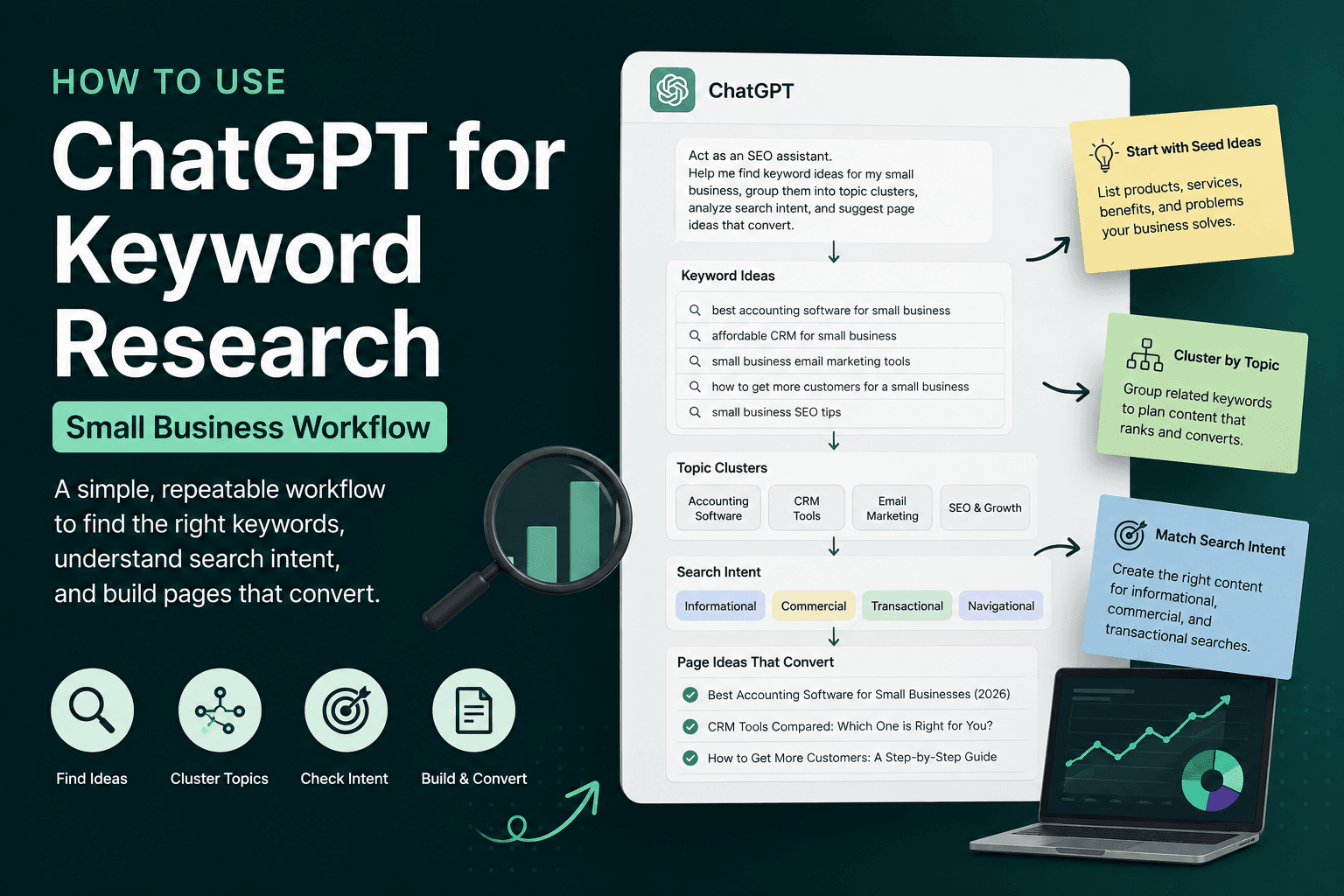
ChatGPT is excellent at expanding keyword ideas. It is a weak source of search volume numbers.
If you treat it like a magic keyword database, you will build pages nobody searches for. If you treat it like a research assistant inside a real workflow, you can build a clean topic map in an afternoon.
This guide is the tactical companion to AI SEO for Small Business: a copy-paste ChatGPT for keyword research workflow — seeds, clusters, intent labels, free validation, scoring, and briefs that convert. For drafting habits, see ChatGPT Work for Small Business. More prompts: ChatGPT prompts library.
Table of contents
- Quick summary
- What ChatGPT keyword research is
- Who should use it
- Who should NOT use it
- Quick recommendation
- Things to consider before choosing
- Key features of the workflow
- Best-for table
- Pricing in 2026
- Pros and cons
- Best use cases
- Limitations
- The 6-step workflow
- Comparison tables
- Decision matrix
- Setup checklist
- Common mistakes
- Alternatives and competitor comparison
- FAQ
- Final recommendation
Quick summary
| Step | Action | Output |
|---|---|---|
| 1 | Write 5–15 real seeds | Offer + buyer language + location |
| 2 | Expand into clusters | Primary + secondaries + page type |
| 3 | Label intent | Informational / commercial / transactional / local |
| 4 | Validate free | Autocomplete, PAA, Search Console, SERP skim |
| 5 | Score 1–5 | Commercial value × uniqueness × realism |
| 6 | Write briefs | Then draft — not before |
One cluster = one primary URL. Mixed intents become separate pages.
What ChatGPT keyword research is
ChatGPT keyword research is using a large language model to brainstorm, cluster, label, and brief topics — then validating demand with free search data before you write.
It is not a replacement for Ahrefs, Semrush, or Google Search Console. Those tools (and the live SERP) observe demand. ChatGPT reorganizes language.
| Nearby job | What it solves | Guide |
|---|---|---|
| Full AI SEO system | Content, local, technical, stack | AI SEO playbook |
| On-page optimization scoring | Brief compliance while writing | Surfer SEO review |
| Tool comparison | Surfer vs Frase vs Clearscope | comparison |
| Live web research briefs | Source-backed research | Perplexity for small business |
| Review / local reputation | GBP replies and asks | AI review management |
What ChatGPT can and cannot do
Can: brainstorm related queries; group topics; rewrite seeds for local modifiers; suggest titles and FAQs; turn messy notes into a cluster table.
Should not be trusted for: exact monthly search volume; keyword difficulty scores; “guaranteed rank” claims; competitor backlink facts it cannot verify.
You still need free validation: Google results, Autocomplete, People Also Ask, and Search Console.
Who should use it
This workflow fits when you:
- Own or market a small business site (service, local, e-commerce, agency)
- Can name your offer and service area in plain language
- Will spend an afternoon validating in Google before drafting
- Need a topic map, not another random blog idea
- Already use ChatGPT (free or paid) for writing
Who should NOT use it
Skip this as your only method if:
- You need competitive keyword difficulty and volume at scale every week — buy a keyword suite
- You refuse to open Google or Search Console
- You plan 50 thin city pages with one paragraph swapped
- You want ChatGPT to invent “high volume / low competition” lists as facts
- You have no unique proof (process, photos, niche experience) to add to winners
Quick recommendation
Things to consider before choosing
- Offer clarity — what you sell in one sentence
- Locations you actually serve — not aspirational cities
- Proof you can publish — photos, process, niche examples
- Existing Search Console queries — demand you already have
- Cannibalization risk — one primary per URL
- Local vs national SERPs — directories can be unwinnable for a one-city shop
- Doorway-page risk — thin city swaps
- Brief before draft — outline, proof, CTA, internal links
- Upgrade trigger — weekly publishing volume
- Who owns the topic map — so it stays updated
Key features of the workflow
| Feature | Why it matters |
|---|---|
| Seed list from reality | Starts with buyer language, not jargon |
| Cluster table | Prevents random one-off posts |
| Intent labels | Stops stuffing mixed jobs on one URL |
| Free SERP validation | Grounds ideas in observed search |
| Opportunity scoring | Ships commercial + unique first |
| Content briefs | Connects research to convertible pages |
| Prompt pack | Repeatable without reinventing instructions |
Best-for table
| Profile | Best first clusters | Avoid first |
|---|---|---|
| Local service (HVAC, dental, legal intake) | Emergency + city service page; cost-factors guide | 50 thin suburb pages |
| E-commerce | Problem/solution guides that support product pages | Ranking for brand terms you already own |
| Agency / consultant | Fit + process + niche proof pages | Generic “what is SEO” with no case proof |
| Multi-location | Unique proof per priority market | Identical templates per ZIP |
| New site (no GSC data) | Autocomplete + PAA + competitor title skim | Waiting months to start |
Pricing in 2026
| Layer | Typical cost | Role |
|---|---|---|
| ChatGPT Free | $0 | Light expansion |
| ChatGPT Plus | ~$20/mo (pricing) | Heavier clustering, Projects |
| Google Search Console | Free | Observed queries and pages |
| Google SERP / Autocomplete / PAA | Free | Validation |
| Surfer / Frase / Clearscope | Paid monthly | Later on-page consistency |
| Ahrefs / Semrush-class | Paid monthly | Volume, difficulty, competitors when scale needs it |
A complete Layer 1 map can cost $0–$20/mo. Paid SEO suites are optional upgrades, not prerequisites.
Pros and cons
Pros
- Fast topic maps from messy business language
- Cheap — Free or Plus plus Search Console
- Forces intent labels and one-cluster-one-page discipline
- Briefs improve content quality before drafting
- Works for local modifiers without a huge tool budget
Cons
- Invented volumes look confident and are often wrong
- Easy to create cannibalizing articles if you skip clustering
- No live SERP without validation steps
- Weak without unique proof on the page
- Not a substitute for competitive keyword suites at scale
Best use cases
- Building a first service-page + supporting-guide map for a local business
- Expanding one offer into clusters before a content sprint
- Turning Search Console queries into briefs
- Adding realistic local modifiers only for areas you serve
- Harvesting FAQ questions for money pages vs supporting articles
- Feeding an AI SEO 30-day sprint with prioritized URLs
Limitations
- No reliable exact volume or difficulty from the model alone
- Cannot see your private Search Console data unless you paste exports
- Will happily suggest cities you do not serve
- Will suggest doorway-style local variants unless you forbid them
- Research assistants like Perplexity help with sources; they still need SERP validation for keyword decisions
The 6-step workflow
1. Seed prompts for your offer and city/niche
Write 5–15 seeds from reality:
- Core service (“roof repair”)
- Buyer language (“fix leaking roof before rain”)
- Commercial modifiers (“cost”, “near me”, “best”, “vs”)
- Location (city and neighborhoods you actually serve)
2. Expand into clusters and subtopics
Ask ChatGPT for clusters with primary keyword, secondary keywords, and likely page type (service page vs guide vs FAQ).
3. Label search intent
Force a label per cluster:
- Informational
- Commercial investigation
- Transactional
- Local
If intent is mixed, split into two URLs instead of stuffing one page.
4. Validate with free data
For every keeper cluster:
- Type the primary into Google — note Autocomplete and related searches
- Open People Also Ask — save real questions
- Check Search Console for queries you already receive
- Skim page-one titles — if every result is a national directory and you are a one-city shop, prefer tighter local variants
5. Score opportunities (effort vs payoff)
Score 1–5 on:
- Commercial value (leads to a paid job?)
- Relevance to your offer
- Uniqueness you can add (process, photos, niche proof)
- Competition realism
Ship high commercial + high uniqueness first.
6. Turn winners into briefs and titles
Before drafting, write a brief: primary keyword, intent, audience, proof to include, internal links, and CTA. Then draft. Optimization tools come later — Surfer SEO review when you need consistent on-page checks.
Copy-paste prompt pack
Prompt 1 — Seed expansion
You are an SEO research assistant for a small business.
Business: [type]
Offer: [main offer]
Locations served: [cities/areas]
Seeds: [list]

Expand into 40 keyword ideas. Group into clusters.
For each cluster provide: primary keyword, 5 secondaries, likely intent, suggested URL type (service page or guide).
Do not invent search volumes.
Prompt 2 — Local modifiers
Using this cluster list, add realistic local variants only for areas we serve: [list].
Flag any doorway-page risk (thin city swaps).
Suggest which locations deserve unique proof vs a single service-area section.
Prompt 3 — Intent labeling
Label each cluster as informational, commercial investigation, transactional, or local.
If a cluster mixes intents, split it into separate page recommendations.
Prompt 4 — PAA / FAQ harvest
Generate likely People Also Ask questions for [primary keyword].
Mark which questions belong on the money page vs a supporting article.
Prompt 5 — Brief builder
Write an SEO content brief for [primary keyword].
Include: searcher job-to-be-done, outline (H2/H3), entities to mention, internal links to suggest, proof checklist, meta title (under 60 characters), meta description (under 155 characters), and CTA.
Assume a small business voice. No fake statistics.
More patterns: ChatGPT prompts for small business.
Example: local service topic map
For a fictional residential HVAC repair company in one metro:
| Cluster | Primary page | Intent |
|---|---|---|
| Emergency AC repair + city | Service page | Local / transactional |
| AC not cooling troubleshooting | Supporting guide | Informational |
| AC repair cost factors | Supporting guide | Commercial investigation |
| Maintenance plan benefits | Service / offer page | Commercial |
The blog supports the service page — it does not replace it.
Comparison tables
Table 1 — Research layer roles
| Layer | Best at | Weak at | Cost |
|---|---|---|---|
| ChatGPT | Expansion, clustering, briefs | Volume, difficulty, live SERP | $0–~$20/mo |
| Search Console | Your real queries | Competitor gaps | Free |
| Google Autocomplete / PAA | Live language | Prioritization alone | Free |
| Perplexity | Sourced research notes | Keyword suite metrics | Free–paid |
| Surfer / Frase / Clearscope | On-page guidance | Early topic discovery | Paid |
| Ahrefs / Semrush-class | Volume, KD, competitors | Overkill for day-one maps | Paid |
Table 2 — Page type vs intent
| Intent | Typical URL | ChatGPT help |
|---|---|---|
| Local / transactional | Service page | Local modifiers + CTA brief |
| Informational | Supporting guide | Outline + PAA questions |
| Commercial investigation | Cost / compare guide | Entities + proof checklist |
| Mixed | Split into two URLs | Intent-split prompt |
Decision matrix
Score 1–5 × weight before you buy another SEO tool.
| Criterion | Weight | ChatGPT + GSC + SERP | Add Surfer-class | Add Ahrefs/Semrush-class |
|---|---|---|---|---|
| Speed to first topic map | 5 | |||
| Cost this month | 5 | |||
| Observed demand accuracy | 5 | |||
| On-page consistency at weekly volume | 3 | |||
| Competitive gap analysis | 3 | |||
| Local doorway-risk control | 4 | |||
| Weighted total |
Rule: If ChatGPT + free validation scores highest, do not buy a suite until you publish weekly or need competitor metrics.
Setup checklist
- Offer + locations written in plain language
- 5–15 seeds listed
- Cluster table produced (no invented volumes)
- Intent labeled per cluster
- Top keepers validated in Google + PAA
- Search Console checked (if property exists)
- Opportunities scored 1–5
- Briefs written for top 2 pages
- Internal links planned to money pages
- Owner named for the topic map
Common mistakes
- Trusting ChatGPT’s made-up volume numbers
- Creating five articles that target the same primary keyword
- Building dozens of city pages with one paragraph swapped
- Skipping Search Console when you already have demand data
- Jumping to drafting before briefs and intent labels exist
- Targeting national directory SERPs as a one-city shop without a tighter local angle
- Asking the model for “low competition / high volume” as if it were a database
- Ignoring unique proof — then wondering why pages do not convert
Alternatives and competitor comparison
| If you were about to… | Often better first move |
|---|---|
| Buy Ahrefs/Semrush on day one | Finish ChatGPT + GSC + SERP map for your top offer |
| Buy Surfer before any brief | Write briefs first; add Surfer when publishing weekly |
| Use only Perplexity for keywords | Use it for sources; still validate keyword intent in Google |
| Outsource content with no map | Hand freelancers this cluster table + briefs |
| Jump straight into AI writing | Research → brief → draft inside the AI SEO system |
When to upgrade to Surfer or other SEO tools
Stay with ChatGPT + Search Console until you publish weekly and need faster on-page consistency. Then compare specialized tools in Surfer vs Frase vs Clearscope.
Suggested future article: “Search Console + ChatGPT: monthly query mining workflow for SMBs.”
Frequently Asked Questions
Can ChatGPT replace Ahrefs or Semrush?
No. ChatGPT helps with ideation and clustering. Keyword tools and Search Console provide observed demand and competitive data ChatGPT cannot reliably invent.
How many keywords should one page target?
One primary keyword and a tight set of closely related secondaries in the same cluster. Separate mixed intents into separate URLs.
Should I ask ChatGPT for search volume?
You can ask for relative prioritization hypotheses, but always validate with Autocomplete, SERPs, and Search Console. Do not treat model guesses as volume data.
What is the fastest way to start?
Take one offer, run the seed expansion prompt, validate the top five clusters in Google, and write briefs for the two highest commercial-value pages.
Do I need ChatGPT Plus for keyword research?
No. Free can work for light sessions. Plus (~$20/mo) helps if you hit limits or want Projects for an ongoing topic map — see ChatGPT pricing and ChatGPT Work.
How does this fit local SEO?
Add local modifiers only for areas you serve, flag doorway risk, and prefer unique proof per priority market. Pair with AI SEO and AI review management for local visibility beyond keywords.
Should blogs replace service pages?
No. Supporting guides feed the money page. Transactional/local intent usually belongs on a service URL with a clear CTA.
When should I use Perplexity instead?
Use Perplexity when you need cited research for a brief. Still validate the keyword and intent in Google before you commit to a URL.
Final recommendation
Treat ChatGPT as a clustering and briefing assistant, not a keyword database.
- Seed from your real offer and cities.
- Expand and label intent — no invented volumes.
- Validate keepers in Google + Search Console.
- Score commercial value × unique proof.
- Write briefs, then draft inside the AI SEO playbook.
- Add Surfer-class tools only when weekly publishing needs them.
Keyword research is Layer 1. The businesses that win ship fewer, better pages mapped to real searcher jobs — not longer lists of unverified keywords.
Image prompts for production
Hero (16:9), editorial photography, no logos, no readable UI:
“Wide editorial photograph of a small-business marketer at a desk with printed topic cluster cards arranged in groups, soft window light, notebook and pen, documentary magazine style, no text, no logos, 16:9.”
Supporting image 1 (16:9):
“Over-the-shoulder editorial photo of hands sorting sticky notes into intent piles on a wooden table, warm office light, no readable screen UI, no brand marks, photorealistic, 16:9.”
Supporting image 2 (16:9):
“Documentary-style photo of a local service business owner reviewing a simple printed page outline before a content shoot, workshop background softly blurred, authentic, no logos, 16:9.”
Infographic prompt (16:9):
“Clean editorial infographic on paper-textured background showing six steps: Seed → Expand → Intent → Validate → Score → Brief, geometric icons, charcoal/cream/muted teal, no logos, no tiny UI text, 16:9.”
Metadata (CMS)
| Field | Value |
|---|---|
| Title | How to Use ChatGPT for Keyword Research (Small Business Workflow) |
| Slug | chatgpt-for-keyword-research |
| Primary keyword | ChatGPT for keyword research |
| Secondary keywords | AI keyword research, ChatGPT SEO keywords, keyword clustering ChatGPT, Search Console keyword research, local keyword research AI |
| Semantic keywords | search intent, People Also Ask, Autocomplete, content brief, cannibalization, doorway pages |
| Meta title | ChatGPT for Keyword Research (SMB Workflow 2026) |
| Meta description | A copy-paste ChatGPT keyword research workflow for small businesses — seed ideas, cluster topics, check intent, validate free, and build pages that convert. |
| Excerpt | Use ChatGPT to expand and cluster keywords — then validate with Google and Search Console. Includes prompts, scoring, briefs, and when to upgrade to Surfer-class tools. |
| Category | AI SEO & Local Search (ai-seo) |
| Type | guide |
| JSON-LD | Article + FAQPage + HowTo |
Suggested external references
Key takeaway
A copy-paste ChatGPT keyword research workflow for small businesses — seed ideas, cluster topics, check intent, validate free, and build pages that convert. For more step-by-step guides, browse our blog or explore AI SEO & Local Search.
Frequently asked questions
Can ChatGPT replace Ahrefs or Semrush?
No. ChatGPT helps with ideation and clustering. Keyword tools and Search Console provide observed demand and competitive data ChatGPT cannot reliably invent.
How many keywords should one page target?
One primary keyword and a tight set of closely related secondaries in the same cluster. Separate mixed intents into separate URLs.
Should I ask ChatGPT for search volume?
You can ask for relative prioritization hypotheses, but always validate with Autocomplete, SERPs, and Search Console. Do not treat model guesses as volume data.
What is the fastest way to start?
Take one offer, run the seed expansion prompt, validate the top five clusters in Google, and write briefs for the two highest commercial-value pages.
Do I need ChatGPT Plus for keyword research?
No. Free can work for light sessions. Plus (commonly about $20/mo) helps if you hit limits or want Projects for an ongoing topic map.
How does this fit local SEO?
Add local modifiers only for areas you serve, flag doorway risk, and prefer unique proof per priority market. Pair with a broader AI SEO and local reputation system.
Should blogs replace service pages?
No. Supporting guides feed the money page. Transactional and local intent usually belongs on a service URL with a clear CTA.
When should I use Perplexity instead?
Use Perplexity when you need cited research for a brief. Still validate the keyword and intent in Google before you commit to a URL.
Written by
Maya ChenSenior Editor, AI for Small Business
Maya has tested 120+ AI tools inside real restaurants, clinics, agencies, and brokerages. She writes the reviews and comparisons owners actually use to decide what to buy.
Comments are coming soon
We’re building a discussion space for business owners. Until then, reply to any newsletter issue — we read everything.
Related posts
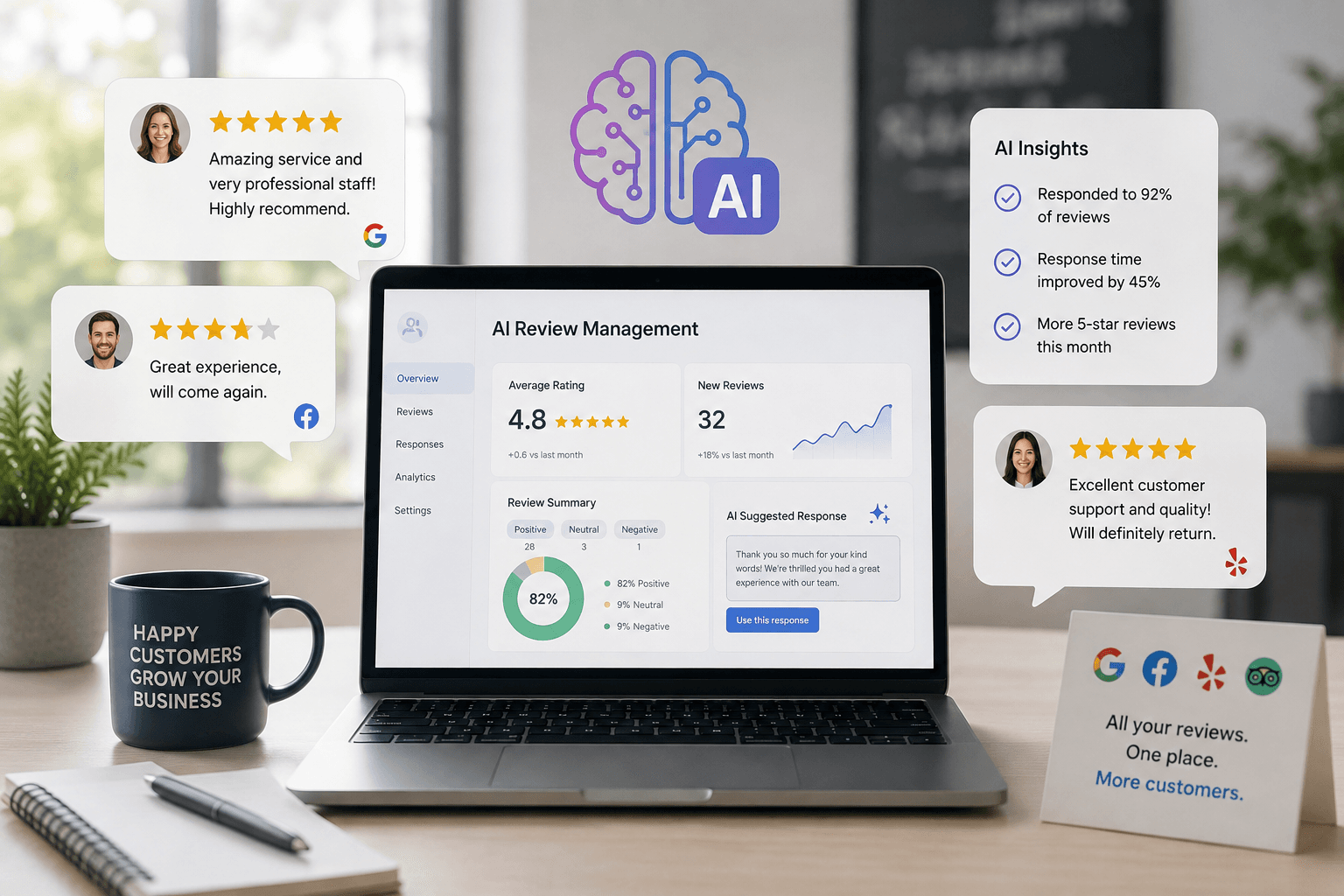
AI Review Management for Small Business: The Complete 2026 Guide
Learn how small businesses use AI to request, triage, and reply to Google reviews without sounding robotic — plus pricing, checklists, and when to stay manual.
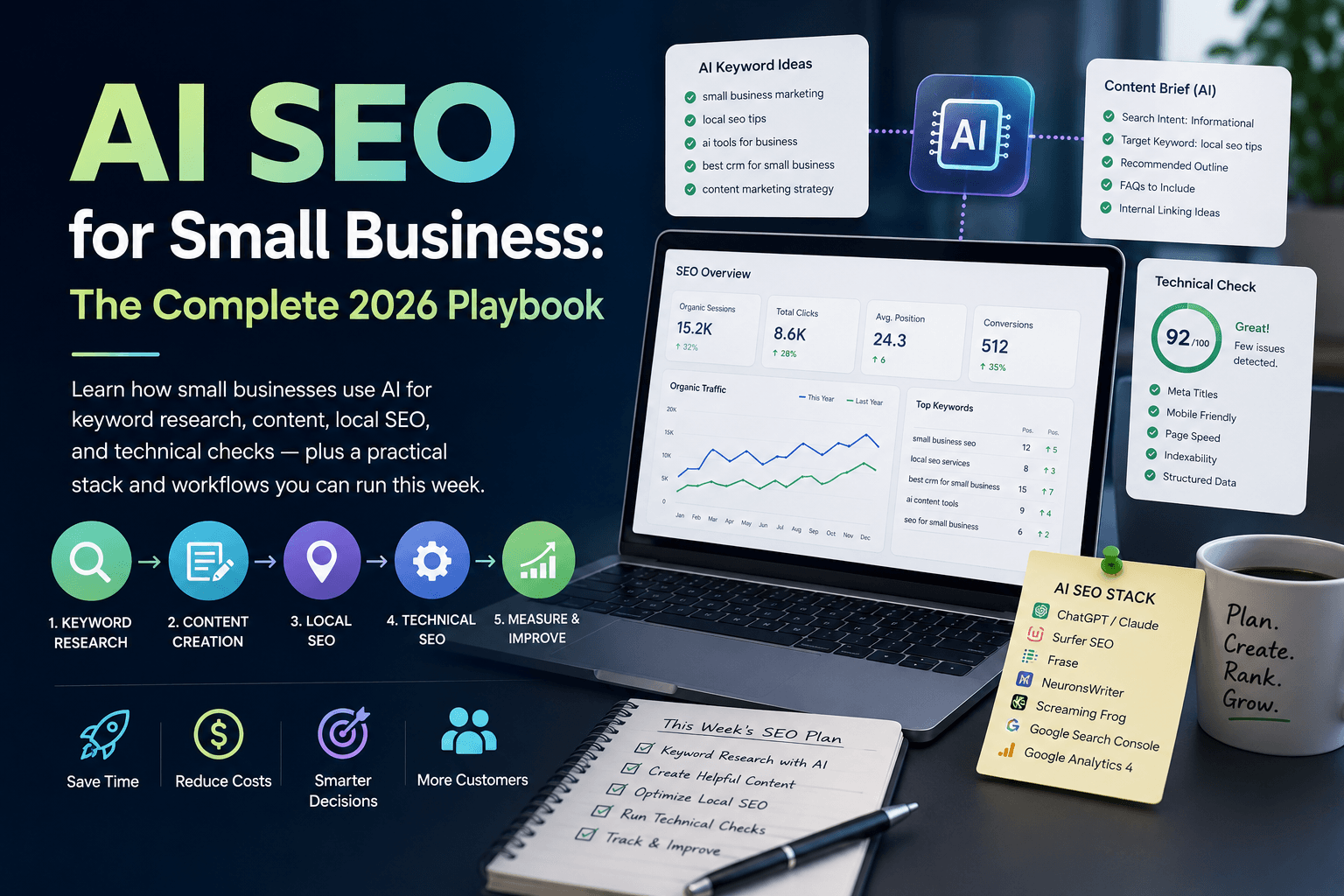
AI SEO for Small Business: The Complete 2026 Playbook
Learn how small businesses use AI for keyword research, content, local SEO, and technical checks — plus a practical stack and a 30-day sprint.
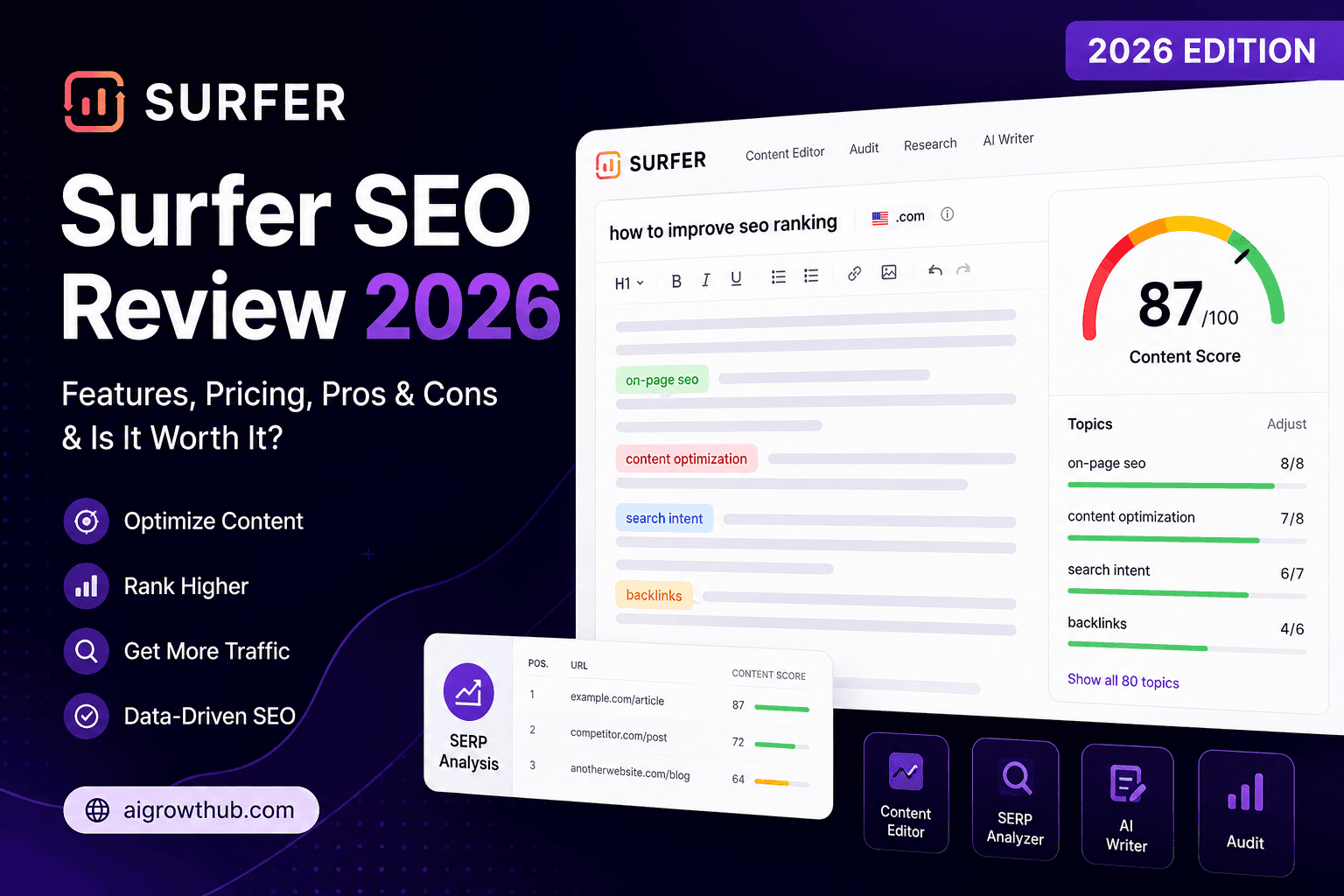
Surfer SEO Review 2026: Pricing, AI Tracker, and Real Fit for Small Teams
Surfer SEO still leads on content optimization, but pricing and AI visibility changed in 2026. See plans, pros, cons, alternatives, and who should actually buy it.
The AI edge, delivered every Tuesday
One 5-minute email: the tools worth your money, the plays that are working right now, and zero hype. Unsubscribe anytime.
No spam. No selling your data. Read by owners of restaurants, gyms, clinics, and agencies across the US, UK, Canada, and Australia.