AI SEO for Small Business: The Complete 2026 Playbook
Learn how small businesses use AI for keyword research, content, local SEO, and technical checks — plus a practical stack and a 30-day sprint.
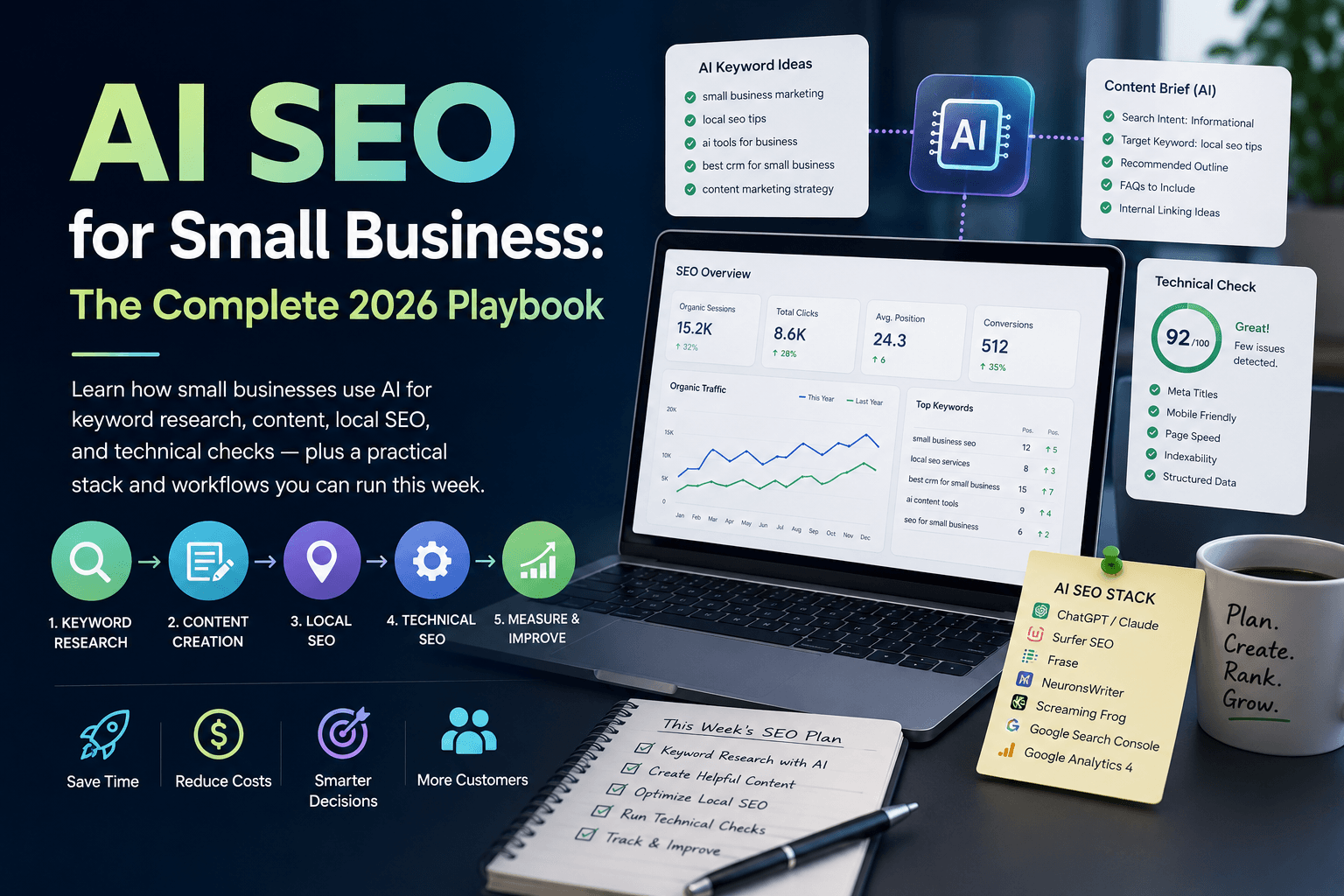
AI can make SEO faster for a small business. It cannot invent customer demand, earn trust for you, or turn thin pages into rankings overnight.
That distinction is the foundation of useful AI SEO for small business in 2026.
This playbook shows how to use AI across keyword research, content, local SEO, technical hygiene, and measurement — without flooding Google with generic pages, buying tools you do not need, or confusing AI SEO with AI marketing. Tactical companions: ChatGPT for keyword research and AI review management.
Table of contents
- Quick summary
- What AI SEO is
- Who should use it
- Who should NOT use it
- Quick recommendation
- Things to consider before choosing
- Key features (the 5 layers)
- Best-for table
- Pricing in 2026
- Pros and cons
- Best use cases
- Limitations
- Comparison tables
- Decision matrix
- 30-day AI SEO sprint
- Setup checklist
- Common mistakes
- Alternatives and competitor comparison
- FAQ
- Final recommendation
Quick summary
| Layer | AI’s job | Your job |
|---|---|---|
| Keywords | Expand and cluster | Validate in Google + Search Console |
| Content | Draft from a brief | Add proof; cut fluff; publish standards |
| Local / GBP | Draft posts, Q&A, reply outlines | Keep NAP true; authentic reviews |
| Technical | Prioritize GSC issues | Fix indexation, speed, duplicates |
| Measure | Summarize exports | Track calls, forms, bookings |
Ship a 30-day sprint before buying a third SEO tool.
What AI SEO is
AI SEO is the use of artificial intelligence to support search work: finding topics, clustering keywords, drafting briefs and pages, summarizing Search Console data, improving on-page clarity, and speeding up local SEO tasks.
It is not:
| Myth | Reality |
|---|---|
| Unedited AI articles at scale | Thin pages underperform |
| “Rank guarantee” software | No honest tool can promise rankings |
| Replacing Search Console | GSC is still your best free demand signal |
| Same as AI marketing | Ads, email, funnels are a different system — AI marketing guide |
AI SEO vs traditional SEO
Traditional SEO still matters: crawlability, relevance, links, local signals, and helpful content. AI changes throughput and decision support. You research faster, draft faster, and spot Search Console patterns sooner. Ranking systems still evaluate whether your page helps a real searcher.
Google AI Overviews, citations, and what still ranks
Results mix classic blue links, local packs, and AI-generated summaries. Your job is not to hack every surface. Your job is to be the clearest, most trustworthy answer for a specific customer problem in a specific market.
Practical implications:
- One primary intent per page
- Original details AI cannot invent: process steps, photos, pricing ranges you stand behind, service-area specifics, anonymized case notes, FAQs from real customers
- Clear entities: business name, location, services, brand identity
What AI can and cannot do
Can: expand keyword ideas, group topics, draft outlines, rewrite for clarity, generate meta options, summarize GSC exports, suggest internal links, draft GBP posts.
Cannot: verify your facts, invent genuine reviews, earn backlinks by magic, fix a weak offer, or overcome a site that is slow, blocked, or irrelevant.
Who should use it
AI SEO fits when you:
- Sell real offers in real geographies (or clear niches)
- Can name conversion events (calls, forms, bookings, orders)
- Will review AI drafts before publish
- Own or can access Google Search Console and Google Business Profile (if local)
- Need faster research and drafting — not a substitute for a product
Typical readers: local services, clinics, agencies, e-commerce, consultants, and freelancers running content for clients.
Who should NOT use it
Skip the “AI SEO overhaul” if:
- The site cannot be crawled/indexed and nobody will fix basics
- You have no unique proof and plan to publish 30 definition posts this weekend
- You want AI to invent stats, licenses, or customer stories
- You are chasing national head terms as a one-location shop with no tighter angle
- Nobody will own weekly refreshes and GBP accuracy
Fix the offer and technical floor first. AI amplifies whatever you feed it.
Quick recommendation
Things to consider before choosing
- Money pages — which URLs should convert this quarter
- Service areas you actually cover — doorway risk if you fake cities
- Proof inventory — photos, process, niche examples
- GSC access — observed queries beat invented volumes
- Publishing cadence — weekly vs occasional
- Editor / owner — who approves facts
- Local vs informational priority — pack vs blog vanity
- Follow-up system — SEO traffic needs nurture (AI marketing)
- Tool ceiling — free stack first; one paid optimizer later
- 30-day success metric — leads and GSC movement, not post count
Key features (the 5 layers)
Layer 1 — Keyword and demand research
Start from offers you sell and places you serve. Expand seeds into clusters, then validate with Autocomplete, People Also Ask, competitor titles, and Search Console. Full workflow: ChatGPT for keyword research.
Layer 2 — On-page and content systems
Every money page needs a brief before a draft: audience, intent, primary keyword, entities, proof, FAQs, internal links, CTA. AI drafts; you add proof and cut fluff. Optional research assist: Perplexity.
Layer 3 — Local SEO and Google Business Profile
Local pack visibility often beats blog vanity traffic. Draft GBP posts, Q&A, and service-area outlines with AI — keep NAP consistent and reviews authentic (review management).
Layer 4 — Technical hygiene (lightweight)
Fix indexation, mobile usability, speed basics, broken links, and thin duplicate URLs. Use AI to prioritize fixes from Search Console exports.
Layer 5 — Measurement, refresh, and EEAT signals
Track impressions, clicks, conversions, and decaying pages. Refresh winners. Show who wrote the content and how you know what you claim.
Best-for table
| Profile | Prioritize first | Defer |
|---|---|---|
| Local service | GBP + service pages + reviews | High-volume national blogs |
| Multi-location | Unique proof per priority market | Thin city swaps |
| E-commerce | Problem guides supporting product URLs | Ranking for brand terms you already own |
| Agency / consultant | Niche proof + process pages | Generic “what is SEO” posts |
| New site | Topic map + 3 money pages | Buying Surfer before anything unique exists |
Industry messaging can borrow from restaurants, dentists, and real estate — this pillar owns the SEO system.
Pricing in 2026
| Stack | Typical monthly posture | What you get |
|---|---|---|
| Free / under ~$50 | GSC + Analytics + GBP + one AI seat (~$0–$20) | Research, drafts, topic map |
| Growth (~$50–$200) | + one content optimizer or research tool | On-page consistency at weekly volume |
| Agency / scaled | Multiple seats + suite tools | Competitive metrics, workflows, reporting |
Surfer / Frase / Clearscope are worth it when cadence and editing exist — not before basics. Details: Surfer review.
Always subtract editor time. Human minutes are part of TCO.
Pros and cons
Pros
- Faster keyword maps, briefs, and drafts without a full-time SEO hire
- Lean stacks work — Search Console plus one AI seat is enough to start
- Local operators can accelerate GBP posts and review replies with guardrails
- GSC + AI prioritization makes technical cleanup less overwhelming
- Connects cleanly to marketing follow-up once traffic arrives
Cons
- Unedited AI content creates thin, ignorable pages at scale
- Invented volumes and fake stats destroy trust
- Tool sprawl before GBP and indexation wastes money
- Doorway city pages can get filtered
- Results still take weeks to months depending on competition
Best use cases
Keyword research without garbage keywords
- List 5–15 seeds from real offers
- Expand problems, comparisons, objections, local variants
- One primary page per cluster
- Label intent: informational, commercial investigation, transactional, local
- Validate — never trust AI volume guesses
Prefer keywords you can win with proof and locality over head terms owned by directories.
90-day topic map aim: 3–5 money pages; 4–8 supporting guides; location set if local; refresh calendar for older URLs.
AI content that ranks
Brief → draft → human edit → optimize.
Brief fields: primary keyword and intent; reader job-to-be-done; must-include facts / must-avoid claims; unique angle; internal links; conversion action.
Then draft with AI, edit like an editor, optimize headings/meta/entities — with or without Surfer-class tools.
EEAT for SMBs: named owner; real photos/examples; clear contact/policies; accurate service-area claims; updates when prices/hours change.
Skip: 2,000 words of definitions with no operational detail; city pages with one swapped name; fake statistics; keyword-stuffed titles; 30 unedited posts in a weekend.
Local SEO with AI
- Service-area pages: neighborhoods you serve, constraints, response times, proof — outline with AI, publish only what you support
- GBP: draft posts and review replies; never fabricate reviews; keep categories/hours accurate
- Citations / NAP: flag inconsistencies with AI; fix website + GBP first, then directories
Technical SEO for non-technical owners
Confirm money URLs are indexable and mobile-friendly. Compress images; clean sitemaps. Export Coverage/Pages and Performance; ask AI to group by impact and propose a one-week fix order.
Schema start simple: LocalBusiness or Organization; Article on guides; FAQPage only when FAQs are visible. Do not spray irrelevant schema.
Visibility beyond blue links
Be quotable for AI Overviews: clear headings, direct first-paragraph answers, original steps, strong entities. Informational queries → snippets; “near me” → GBP, reviews, service pages over blog volume. Brand mentions and real reviews beat random guest posts.
Limitations
- AI does not guarantee rankings
- Cannot invent genuine reviews or backlinks
- Weak offers stay weak with better copy
- National SERPs may be unrealistic for one-city shops
- Marketing follow-up is separate work — do not expect SEO alone to nurture leads
Comparison tables
Table 1 — Stack by job
| Job | Start here | Upgrade when |
|---|---|---|
| Clustering / briefs | ChatGPT or Claude | Weekly volume needs Projects/team seats |
| Observed demand | Search Console | Competitor gap tools at scale |
| On-page consistency | Manual brief checklist | Surfer / Frase / Clearscope |
| Local reputation | GBP + AI reply drafts | Review platforms at high volume |
| Sourced research | Perplexity (optional) | When briefs need citations fast |
Table 2 — AI SEO vs AI marketing vs AI content tools
| System | Optimizes for | Guide |
|---|---|---|
| AI SEO | Search visibility and page usefulness | This playbook |
| AI marketing | Ads, email, funnels, campaigns | AI marketing |
| AI writers (e.g. Jasper) | Content production throughput | Jasper review |
| Keyword workflow | Topic maps and briefs | ChatGPT keyword research |
Decision matrix
Score 1–5 × weight before buying the next SEO tool.
| Criterion | Weight | Free stack (GSC + AI chat) | + On-page optimizer | + Full SEO suite |
|---|---|---|---|---|
| Cost this month | 5 | |||
| Speed to first money-page rewrite | 5 | |||
| Observed demand accuracy | 5 | |||
| On-page consistency at weekly cadence | 3 | |||
| Competitive gap depth | 3 | |||
| Local / GBP workflow fit | 4 | |||
| Weighted total |
Rule: If free stack wins, finish the 30-day sprint before paying for suites.
30-day AI SEO sprint
Week 1 — Map
Confirm offer keywords, build clusters, pick 6 URLs (3 money + 3 support). Baseline GSC. Use keyword research workflow.
Week 2 — Fix
Technical quick wins + GBP completeness + internal links between money pages. Start authentic review asks (review management).
Week 3 — Publish
Ship or rewrite the top 2 money pages: brief → AI draft → human edit.
Week 4 — Support + measure
Publish 2 supporting articles, add FAQs, request reviews, mine GSC for title/meta wins. Align follow-up with 30-day AI marketing plan if needed.
Setup checklist
- Offer + service areas written in plain language
- Search Console + Analytics connected
- GBP complete (if local): categories, hours, services, photos
- Topic map: 3–5 money pages + supporting URLs
- Briefs written before drafts
- Proof checklist per money page (photos, process, FAQs)
- NAP consistent on site + GBP
- Indexation check on money URLs
- Conversion events defined (call, form, book)
- Weekly refresh / review owner named
- 30-day baseline metrics recorded
Common mistakes
- Buying three SEO tools before fixing indexation and GBP
- Publishing AI blogs with no service-page strategy
- Targeting national head terms as a one-location business
- Doorway city pages with no unique proof
- Measuring “posts published” instead of calls, forms, and booked jobs
- Letting AI invent stats, licenses, or customer stories
- Ignoring Search Console for months
- Treating AI SEO as a substitute for AI marketing follow-up
Alternatives and competitor comparison
| If you were about to… | Often better first move |
|---|---|
| Hire an agency on day one | Run the 30-day sprint; bring results to the sales call |
| Buy Surfer before any brief | Write two money-page briefs; then evaluate Surfer |
| Publish 30 AI posts this weekend | Map clusters; ship 2 money pages with proof |
| Only chase AI Overviews tactics | Make money pages the best answer first |
| Ignore reviews while blogging | Add AI review management |
Suggested future article: “AI Overviews for local service businesses: how to become the cited answer.”
Frequently Asked Questions
Does AI SEO actually work for small businesses?
Yes when AI speeds up research, drafting, and analysis while humans own strategy, facts, proof, and publishing standards. AI does not guarantee rankings.
Will Google penalize AI-generated content?
Google evaluates helpful, reliable, people-first content. Unedited, thin, or deceptive AI pages underperform. Human review and original experience matter more than the drafting method.
What is the best AI SEO tool for beginners?
Start with Google Search Console plus ChatGPT or Claude. Add Surfer, Frase, or Clearscope only when you publish consistently and need on-page consistency — see Surfer vs Frase vs Clearscope.
How should a local business prioritize AI SEO?
Fix Google Business Profile, service pages, reviews, and NAP consistency before publishing a high volume of blog posts.
How long until AI SEO shows results?
Technical and GBP fixes can move sooner. New content often needs weeks to months depending on competition, authority, and uniqueness. Track Search Console and leads, not vanity rankings alone.
Is AI SEO the same as AI marketing?
No. AI SEO focuses on search visibility and page usefulness. AI marketing covers ads, email, and funnels. They should connect — see AI marketing for small business — not duplicate.
Do I need keyword volume tools on day one?
No. Use Autocomplete, PAA, SERP skims, and Search Console. Full workflow: ChatGPT for keyword research.
Where do reviews fit?
Reviews and replies are local ranking and conversion signals. Use AI review management alongside service pages — do not fabricate reviews.
Final recommendation
Treat AI SEO as a system with five layers, not a content faucet.
- Map one offer with ChatGPT keyword research.
- Rewrite one money page with brief → AI draft → human edit.
- Complete GBP and draft two posts; keep reviews authentic.
- Fix obvious technical blockers from Search Console.
- When volume grows, evaluate Surfer against alternatives.
- Connect SEO leads to AI marketing follow-up.
The businesses that win publish fewer, better, proof-heavy pages for real offers — and let AI accelerate the work humans still own.
Image prompts for production
Hero (16:9), editorial photography, no logos, no readable UI:
“Wide editorial photograph of a small-business owner at a desk with printed service-page outlines and a simple topic map on paper, soft morning window light, documentary magazine style, no text, no logos, 16:9.”
Supporting image 1 (16:9):
“Over-the-shoulder editorial photo of hands annotating a printed content brief with a pen, warm office light, no readable laptop UI, no brand marks, photorealistic, 16:9.”
Supporting image 2 (16:9):
“Documentary-style photo of a local storefront Google Business Profile style moment — owner updating a chalkboard hours sign outside the shop, late afternoon light, authentic, no logos, no readable phone screens, 16:9.”
Infographic prompt (16:9):
“Clean editorial infographic on paper-textured background showing five SEO layers: Keywords → Content → Local → Technical → Measure, geometric icons, charcoal/cream/muted teal, no logos, no tiny UI text, 16:9.”
Metadata (CMS)
| Field | Value |
|---|---|
| Title | AI SEO for Small Business: The Complete 2026 Playbook |
| Slug | ai-seo-for-small-business |
| Primary keyword | AI SEO for small business |
| Secondary keywords | AI SEO tools, local SEO AI, Google Business Profile AI, AI keyword research, AI content SEO, Search Console AI |
| Semantic keywords | EEAT, topic clusters, AI Overviews, NAP, service-area pages, content briefs |
| Meta title | AI SEO for Small Business (Complete 2026 Playbook) |
| Meta description | Learn how small businesses use AI for keyword research, content, local SEO, and technical checks — plus a practical stack and a 30-day sprint. |
| Excerpt | The definitive 2026 AI SEO system for SMBs: five layers, lean stacks, local + content workflows, checklists, and when to buy Surfer-class tools. |
| Category | AI SEO & Local Search (ai-seo) |
| Type | guide |
| JSON-LD | Article + FAQPage + HowTo |
Suggested external references
Key takeaway
Learn how small businesses use AI for keyword research, content, local SEO, and technical checks — plus a practical stack and a 30-day sprint. For more step-by-step guides, browse our blog or explore AI SEO & Local Search.
Frequently asked questions
Does AI SEO actually work for small businesses?
Yes when AI speeds up research, drafting, and analysis while humans own strategy, facts, proof, and publishing standards. AI does not guarantee rankings.
Will Google penalize AI-generated content?
Google evaluates helpful, reliable, people-first content. Unedited, thin, or deceptive AI pages underperform. Human review and original experience matter more than the drafting method.
What is the best AI SEO tool for beginners?
Start with Google Search Console plus ChatGPT or Claude. Add Surfer, Frase, or Clearscope only when you publish consistently and need on-page consistency.
How should a local business prioritize AI SEO?
Fix Google Business Profile, service pages, reviews, and NAP consistency before publishing a high volume of blog posts.
How long until AI SEO shows results?
Technical and GBP fixes can move sooner. New content often needs weeks to months depending on competition, authority, and uniqueness. Track Search Console and leads, not vanity rankings alone.
Is AI SEO the same as AI marketing?
No. AI SEO focuses on search visibility and page usefulness. AI marketing covers ads, email, and funnels. They should connect, not duplicate.
Do I need keyword volume tools on day one?
No. Use Autocomplete, People Also Ask, SERP skims, and Search Console. Follow the ChatGPT keyword research workflow for clustering and briefs.
Where do reviews fit?
Reviews and replies are local ranking and conversion signals. Use an AI review management workflow alongside service pages — do not fabricate reviews.
Written by
Maya ChenSenior Editor, AI for Small Business
Maya has tested 120+ AI tools inside real restaurants, clinics, agencies, and brokerages. She writes the reviews and comparisons owners actually use to decide what to buy.
Comments are coming soon
We’re building a discussion space for business owners. Until then, reply to any newsletter issue — we read everything.
Related posts
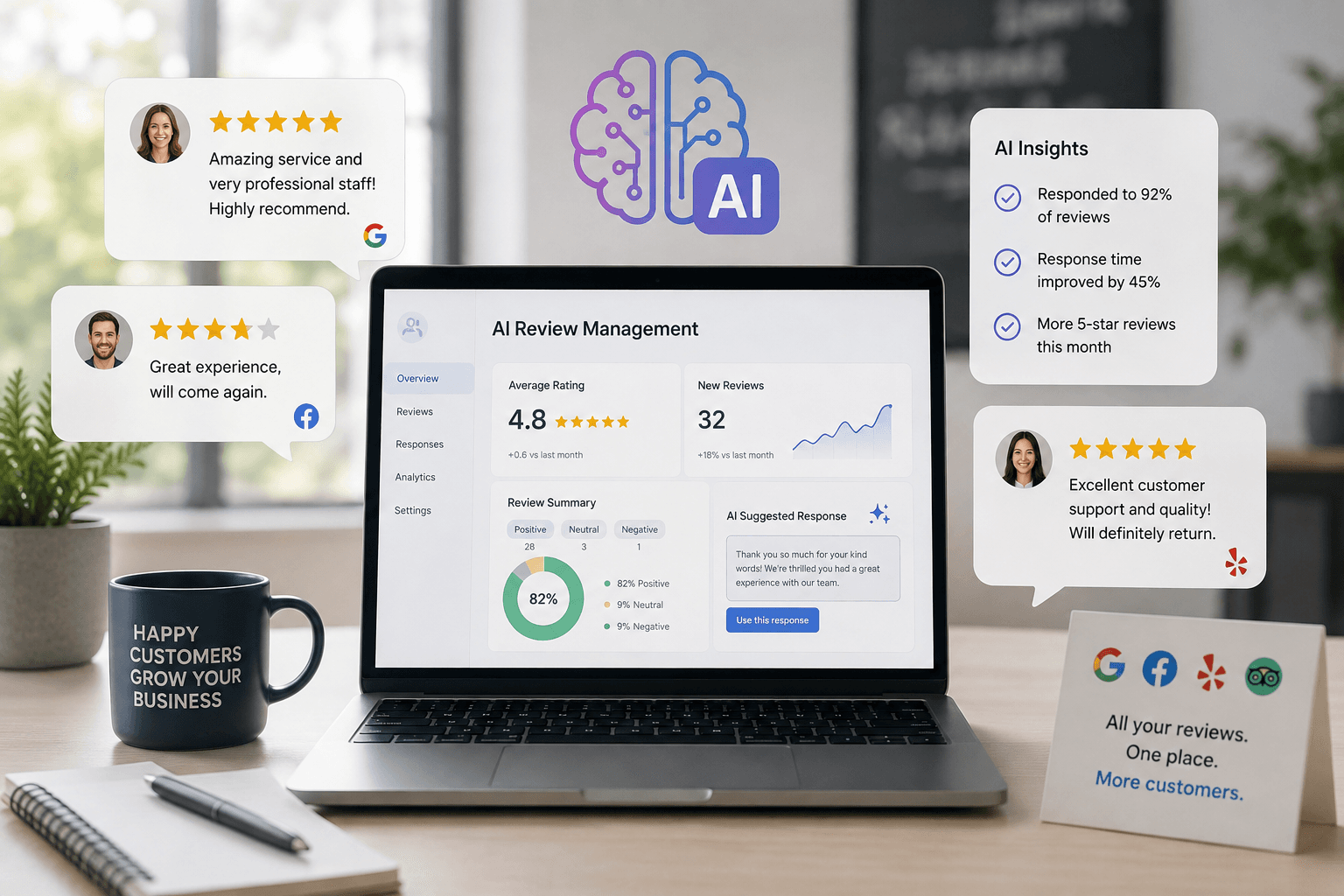
AI Review Management for Small Business: The Complete 2026 Guide
Learn how small businesses use AI to request, triage, and reply to Google reviews without sounding robotic — plus pricing, checklists, and when to stay manual.
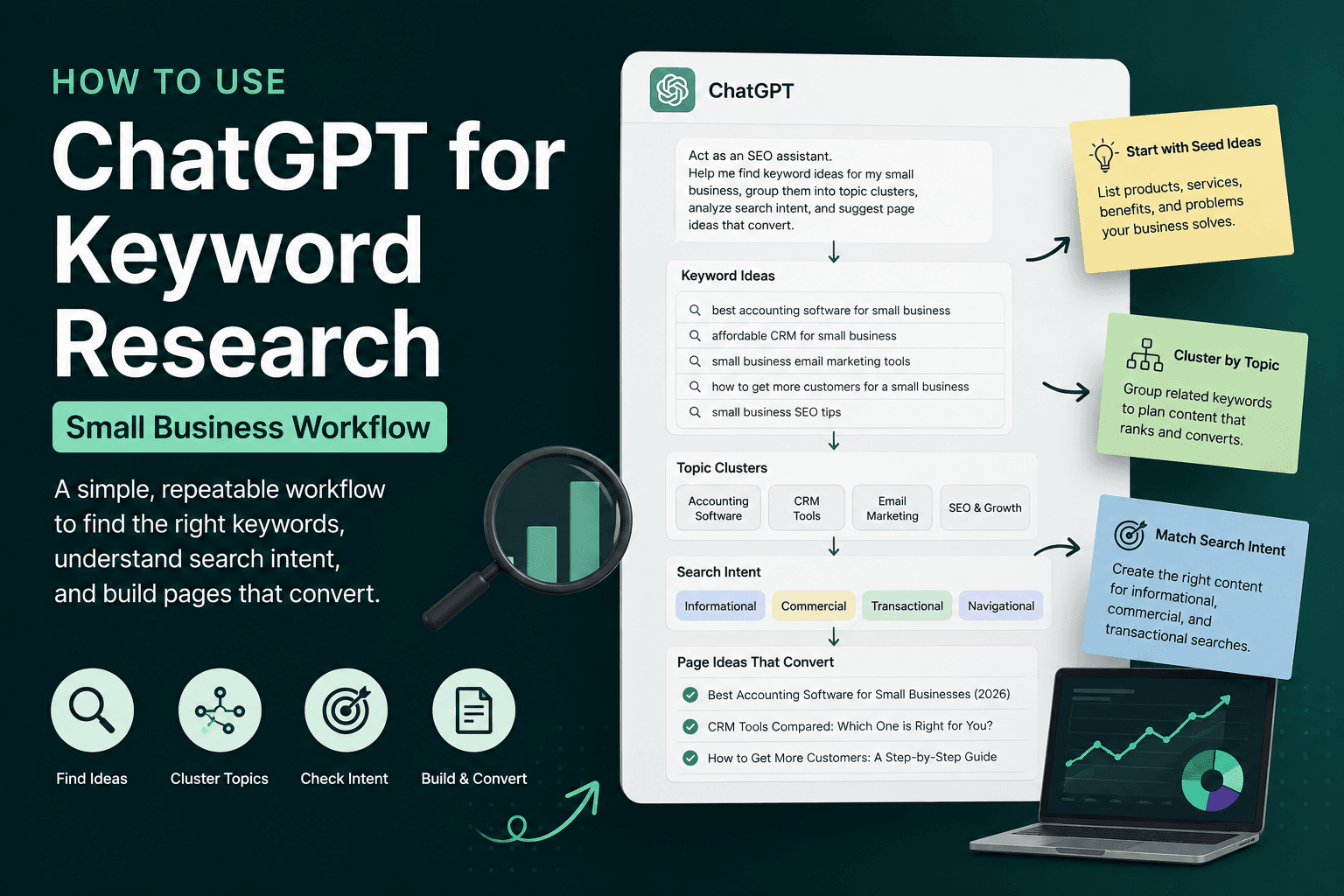
How to Use ChatGPT for Keyword Research (Small Business Workflow)
A copy-paste ChatGPT keyword research workflow for small businesses — seed ideas, cluster topics, check intent, validate free, and build pages that convert.
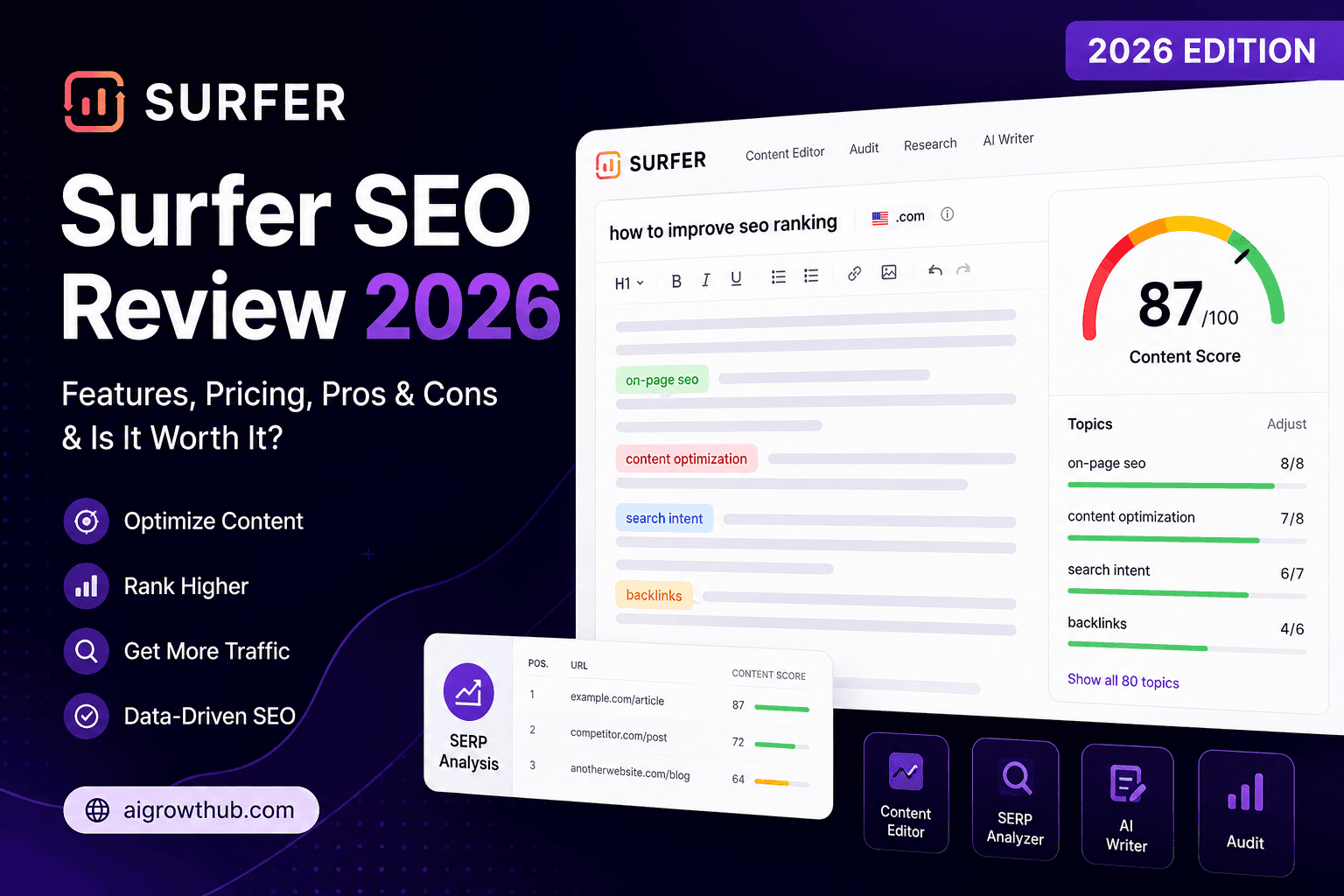
Surfer SEO Review 2026: Pricing, AI Tracker, and Real Fit for Small Teams
Surfer SEO still leads on content optimization, but pricing and AI visibility changed in 2026. See plans, pros, cons, alternatives, and who should actually buy it.
The AI edge, delivered every Tuesday
One 5-minute email: the tools worth your money, the plays that are working right now, and zero hype. Unsubscribe anytime.
No spam. No selling your data. Read by owners of restaurants, gyms, clinics, and agencies across the US, UK, Canada, and Australia.