AI Marketing for Small Business: Complete 2026 Guide to Strategy, Tools & ROI
Practical AI marketing for small business in 2026: workflows, lean stack pricing, decision matrix, checklists, risks, Google SEO guidance, and how to measure ROI.
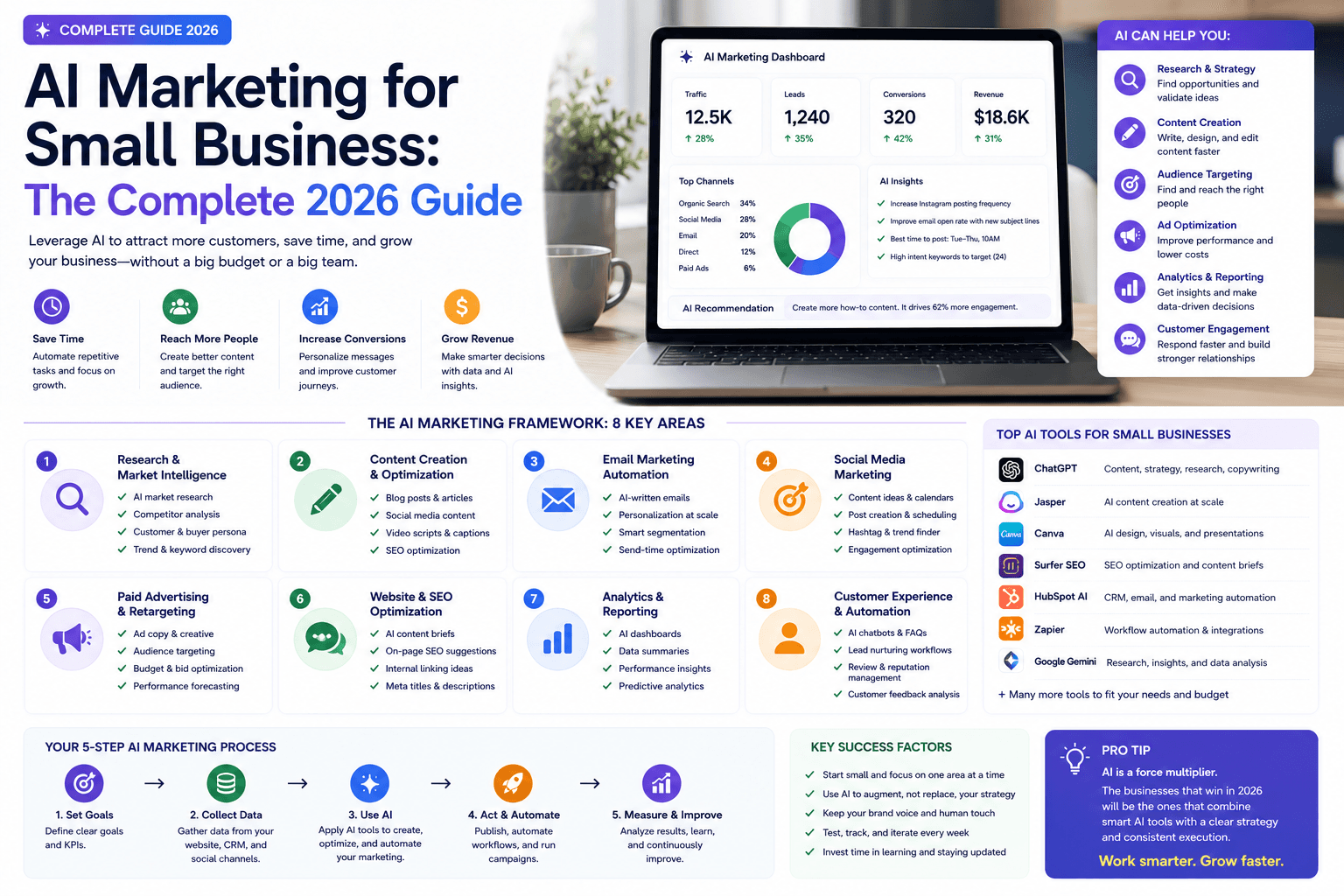
AI marketing helps a small business move faster. It does not invent a customer, fix a weak offer, or replace judgment.
That distinction matters more in 2026 than the tool list. Adoption is rising — the U.S. Chamber of Commerce reported that 58% of surveyed U.S. small businesses self-identified as using generative AI in 2025, while a separate NFIB survey found 24% of small employers using AI technologies. Different samples, different definitions. The useful takeaway is simpler: more owners are experimenting, and the winners treat AI as a workflow — not a shortcut to publish more noise.
This guide is for owners, agencies, freelancers, and consultants who want a practical system: research support, drafting, email, ads, follow-up, measurement, and risk control. For tool shortlists, see best AI marketing tools for small business. For a four-week rollout, use the 30-day AI marketing plan.
Table of contents
- What is AI marketing?
- Who should use it
- Who should not use it
- Key features of a working system
- Pricing: what a lean stack costs
- Pros and cons
- Best use cases
- Limitations
- Comparison tables
- Decision matrix
- Things to consider before choosing
- Common mistakes
- Implementation checklist
- Alternatives and competing approaches
- Frequently asked questions
- Final recommendation
Quick summary
AI marketing is the use of artificial intelligence inside a marketing process — research, creative drafting, personalization, automation, and reporting — with a human owner for strategy and quality.
For most small businesses, the highest-return first jobs are: synthesizing customer language, turning an approved brief into draft assets, adapting one message across channels, speeding lead follow-up, and summarizing campaign data. The lowest-return pattern is “generate more posts” with no offer, no proof, and no metric.
Google’s public guidance remains quality-first: content is judged on helpfulness and reliability, not on whether AI assisted the draft. See Google’s guidance on AI-generated content and creating helpful, people-first content.
What is AI marketing?
AI marketing means applying machine learning and generative models to marketing work. In practice for small teams, that usually looks like:
- clustering themes from reviews, call notes, surveys, and support tickets;
- expanding an approved campaign brief into outlines and angle options;
- drafting email, social, ad, and landing-page variations;
- repurposing one original asset into multiple formats;
- suggesting lead scores or next steps from defined CRM fields;
- answering approved FAQs on a site or inbox;
- summarizing performance exports and flagging anomalies to investigate.
It is not an autopilot. A usable system still needs a target customer, a clear offer, source material your business owns, a quality bar, a named owner, and a success metric tied to revenue or qualified demand.
If that sentence feels vague, AI will multiply the vagueness. Write this first:
We help [specific customer] solve [expensive problem] when [trigger].
Then build a source pack: pricing facts, objections, testimonials you may use, limitations, tone rules, compliance notes, and examples of your best existing copy. That pack is what separates useful output from generic filler.
Who should use it
AI marketing fits when:
- Owners and operators run marketing themselves and need speed on drafting, research, and follow-up without hiring a full team.
- Agencies and freelancers need consistent first drafts and repurposing across clients, with human review still in the loop.
- Consultants want structured research synthesis and proposal variants without inventing client facts.
- Local service businesses (clinics, trades, gyms, restaurants, agencies) already have demand signals — reviews, calls, forms — and need faster response and clearer messaging.
- Teams with one bottleneck that repeats weekly (email sequences, blog drafts, ad hooks, lead replies) and can measure before/after for 30 days.
If you already have an offer that converts in sales conversations, AI is a force multiplier. If the offer does not convert, fix positioning first.
Who should not use it
Skip or heavily restrict AI marketing when:
- You plan to publish unverified health, legal, financial, or earnings claims.
- You would paste customer lists, medical data, passwords, or confidential strategy into unapproved consumer tools.
- Your “strategy” is only “rank for keywords” with no audience or proof — that path collides with Google’s spam policies when automation is used primarily to manipulate rankings.
- You want to replace sales relationships, complaint handling, refunds, or crisis responses with bots and no escalation path.
- You cannot assign a human reviewer. Unreviewed volume is a brand and compliance risk, not a growth plan.
- Your market requires licensed advice you are not qualified to give — AI does not create a license.
In those cases, use AI for internal outlines and admin only — or hire specialists and keep AI out of customer-facing claims.
Key features of a working system
Treat these as system capabilities, not software brand features.
1. Research synthesis
Group language from reviews, tickets, and interviews. Extract phrases customers use for problems and outcomes. Verify every theme against source notes. Do not invent interviews.
2. Briefing and drafting
A strong brief states audience, problem, desired reader action, approved facts, banned claims, tone, and format. The draft is raw material. Add original examples, screenshots, proof, and primary-source links before publish. Prompt libraries help — see ChatGPT prompts for small business.
3. Channel adaptation
One core message becomes email, social, ads, and landing-page sections. Pair with channel playbooks: AI email marketing, AI social media, and AI SEO.
4. Follow-up and routing
Draft replies from CRM fields, summarize discovery calls, suggest next steps. Works only when response time, qualification rules, and ownership are already defined. See AI lead generation workflows and HubSpot vs Pipedrive AI.
5. Creative and ad variation
Turn one approved offer into hooks and creative briefs. Ad platforms and consumer-protection rules still apply. Do not generate unsupported performance claims.
6. Reporting support
Feed clean exports. Ask for calculations with formulas or row references. Treat surprising conclusions as hypotheses.
7. Governance
Review checklists, consent records, vendor settings, and escalation paths. Without governance, “features” become liabilities.
The seven-step operating loop
Use this loop every week. It keeps AI inside a process instead of becoming random chat windows.
- Define one business outcome close to revenue: qualified consults, booked appointments, purchases, trials, or quote requests. “Post more” is an activity, not an outcome.
- Choose one audience and one problem using the sentence template above.
- Build or refresh the source pack before you prompt.
- Assign AI one narrow job — themes, outline, challenge the offer, draft variations, or score a page against a rubric. Avoid “do my marketing.”
- Review with a checklist (facts, privacy, voice, usefulness, CTA match, current prices/links).
- Publish through one repeatable channel where attention already exists.
- Measure and improve with a simple scorecard:
| Metric | Why it matters | Review |
|---|---|---|
| Qualified leads | Right people, not just traffic | Weekly |
| Lead-to-customer rate | Message + sales quality | Monthly |
| Revenue influenced | Business value | Monthly |
| Cost per qualified lead | Efficiency guardrail | Weekly |
| Hours saved | Productivity case | Weekly |
| Unsubscribe / complaint rate | Quality alarm | Every send |
Pricing: what a lean stack costs
Do not buy software by category. Buy it by workflow. Public list prices change; verify on vendor pages before you commit. The ranges below reflect commonly listed consumer and SMB tiers as of August 2026.
Starter lean
$20–60/month
Solo owner, one channel, human review
- One general AI assistant (e.g. ChatGPT Plus or Claude Pro ~$20/mo)
- Existing email or CRM free/starter tier
- Canva free or Pro if visuals matter (~$15/mo)
- Built-in analytics on your site or GBP
- No specialized SEO or ad AI yet
Growth stack
$100–250/month
Active content + email + light ads
- General AI assistant kept as the drafting core
- Dedicated email tool with list limits that match volume
- Optional SEO assistant (entry plans often ~$40–90/mo)
- Design tool with brand kit
- Analytics tied to one conversion event
Ops / agency layer
$300+/month
Teams, multi-brand, or all-in-one hubs
- Brand-voice marketing writers (e.g. Jasper-class tools)
- CRM + marketing automation seats
- Meeting notes / call intelligence if sales-heavy
- Workflow automation (Zapier/Make/n8n class)
- Budget for review time — still the real cost
Reality check: HubSpot-class Marketing Hub Professional tiers are often hundreds of dollars per month according to HubSpot’s pricing pages — useful when inbound + CRM must share one database, expensive as a first AI experiment. A $20 assistant plus discipline usually beats a $800 suite with no process.
For writing-tool tradeoffs, compare Jasper vs Copy.ai vs ChatGPT. For automation wiring, see AI automation for small business.
ROI model (conservative)
Monthly value ≈ (hours saved × loaded hourly cost) + incremental gross profit
Subtract software fees, setup, training, review/correction time, and contractor costs. If the only gain is “more posts,” ROI is not proven.
Pros and cons
Pros
- Speeds research clustering, first drafts, and asset adaptation
- Makes one-person marketing ops more consistent week to week
- Lowers the cost of testing hooks and subject lines
- Helps turn call notes and reviews into usable messaging inputs
- Supports reporting summaries when data exports are clean
- Scales freelancers and small agencies without linear hiring
Cons
- Hallucinated facts, quotes, and citations if unchecked
- Generic voice that erodes trust when source packs are thin
- Privacy risk when customer or confidential data is pasted into tools
- Tool sprawl and unused subscriptions without owners or metrics
- Over-automation of sensitive or high-value conversations
- False confidence — volume without conversion looks like progress
Best use cases
| Scenario | Best first AI job | Primary metric | Avoid |
|---|---|---|---|
| Local service business | Review + FAQ synthesis → GBP/email replies | Booked consults / calls | Daily generic social calendars |
| Ecommerce or retail | PDP drafts + email win-back variants | Conversion rate + repeat purchase | Invented reviews or fake scarcity |
| B2B consultant / agency | Proposal outlines + case study drafts from approved notes | Qualified pipeline | Fabricating client results |
| Content-led SMB | Brief → outline → draft with human proof | Organic leads / assisted conversions | Unedited mass publish for keywords |
| Sales-led team | Call summary → CRM next step + follow-up draft | Speed-to-lead + win rate | Bot-only negotiation |
| Recommendation | One weekly bottleneck ≥2 hours | Time + qualified demand | Buying five tools in week one |
Best for (by role)
| Role | Best fit | Start here |
|---|---|---|
| Solo owner | Starter lean stack | One assistant + one channel |
| Freelancer | Drafting + repurposing SOPs | Prompt library + review checklist |
| Agency | Brand voice + QA workflow | Shared source packs per client |
| Consultant | Research synthesis + proposals | Redact confidential inputs |
| Marketing hire (first) | Ops + measurement | Scorecard before new tools |
Limitations
AI marketing systems struggle with:
- Strategy. Models remix patterns; they do not know your unit economics unless you supply them.
- Truth. Plausible text is not evidence. Prices, dates, legal claims, and testimonials need primary sources.
- Originality that ranks. Google Search emphasizes original value, clear authorship, and people-first purpose. Thin AI pages fail that bar.
- Trust in regulated categories. Extra care for YMYL topics (health, money, safety).
- Relationship work. High-value closes, complaints, and exceptions need humans.
- Attribution magic. AI cannot invent clean tracking. Define UTM conventions and conversion events yourself.
Risks to manage explicitly
Accuracy. Require primary sources for claims, prices, quotations, and dates.
Privacy. Do not paste customer lists, health information, legal documents, passwords, or confidential strategy into unapproved tools. Review vendor settings and contracts before processing sensitive data.
Copyright and brand. Use your own source material and licensed assets. Do not instruct a system to imitate a living creator or copy a competitor’s distinctive expression. Keep records for important claims and creative approvals.
Generic content. Add details a broad prompt cannot invent: your process, constraints, customer questions, decision criteria, and lessons learned.
Over-automation. Keep humans on complaints, refunds, crisis responses, and high-value sales conversations unless a clear escalation path exists.
Advertising rules. Ad platforms and consumer-protection expectations still apply to AI-assisted copy. Unsupported earnings, health, or performance claims remain a business risk regardless of who typed the first draft.
What Google wants from content (practical version)
Google’s public materials ask publishers to make the who, how, and why clear. For AI-assisted marketing pages that means:
- identify the author or editorial owner;
- explain research or evaluation methods when useful;
- publish to solve a reader problem, not only to capture a keyword;
- add original analysis and verify automated output;
- update time-sensitive facts.
There is no legitimate method that guarantees first place in search. Relevance, originality, links, technical accessibility, competition, and time all influence performance.
Comparison tables
Table 1 — Approach comparison (how you run marketing)
| Approach | Monthly software signal | Speed | Quality risk | Best when |
|---|---|---|---|---|
| AI-assisted DIY | $20–100 | High | Medium — needs checklist | Owner has an offer that already sells |
| Specialized AI stack | $100–300 | High | Medium — sprawl risk | Clear volume in content/email/SEO |
| All-in-one marketing suite | $300–1,000+ | Medium | Lower if process is built-in | Inbound + CRM must share data |
| Agency / freelancer only | Fees vary | Depends on retainer | Lower if specialists own QA | You will not review weekly |
| Traditional marketing only | Ads + tools without AI | Lower drafting speed | Depends on talent | Compliance-heavy claims |
| Bottom line | Match cost to volume | Process beats model brand | Human review is non-negotiable | Start DIY lean, upgrade by bottleneck |
Table 2 — Capability comparison (general assistant vs marketing suite vs SEO suite)
| Capability | General AI assistant | Marketing content suite | SEO optimization suite |
|---|---|---|---|
| Campaign brainstorming | Strong | Strong | Moderate |
| Brand voice at team scale | Moderate (projects/custom) | Strong | Weak |
| SERP-aligned drafting | Moderate with good briefs | Moderate | Strong |
| Email sequence drafting | Strong | Strong | Weak |
| CRM + automation | Weak alone | Varies by product | Weak |
| Learning curve | Low | Medium | Medium |
| Typical entry price signal | ~$20/user/mo | ~$40–70+/mo | ~$40–130+/mo |
| Upgrade trigger | Hit usage limits / need shared workspace | Multi-brand + collaboration | Publishing volume needs scoring |
Decision matrix
Score each option 1–5 for your situation. Weight what matters; ignore vanity features.
| Criterion (weight) | Lean AI DIY | Specialized stack | All-in-one suite | Agency-led |
|---|---|---|---|---|
| Time to first useful output (×3) | ||||
| Fit to one clear bottleneck (×3) | ||||
| Monthly cost vs volume (×2) | ||||
| Data privacy / admin controls (×2) | ||||
| Collaboration needs (×1) | ||||
| Measurement readiness (×2) | ||||
| Weighted total |
Things to consider before choosing
- Outcome. What number moves — booked calls, purchases, quotes — not “engagement.”
- Audience sentence. If you cannot write it in one line, pause tool shopping.
- Source pack. Without approved facts and examples, output stays generic.
- Owner. Who reviews every public asset? Name them.
- Consent and data. Where do customer records live? Which vendors are allowed?
- Channel focus. One primary channel beats five half-maintained ones.
- Baseline. Hours and results for two weeks before AI changes.
- Compliance. Ads, testimonials, and industry rules still apply to AI-assisted copy.
- Exit cost. Can you export content and contacts if you cancel?
- Upgrade trigger. Write the metric that justifies the next subscription.
Common mistakes
- Buying categories, not workflows. Five logos, zero weekly ritual.
- Prompting “do my marketing.” Hides assumptions; quality becomes unjudgeable.
- Publishing unedited drafts. Fast path to thin, interchangeable pages.
- Skipping the source pack. The model fills gaps with plausible fiction.
- Measuring vanity volume. Posts and words are not revenue.
- Pasting private data into consumer chats. Privacy and contract risk.
- Automating complaints and refunds. Needs escalation, not templates alone.
- Chasing every new model release. Process beats novelty.
- Ignoring deliverability and consent. AI subject lines do not fix a dirty list.
- Expecting AI to invent product-market fit. It amplifies what you already have.
Implementation checklist
Use this before you expand beyond one workflow.
- One revenue-linked outcome written down
- One audience × one problem statement
- Source pack created (facts, proof, bans, tone)
- Baseline hours and results recorded (2 weeks)
- Single AI role assigned for the pilot (e.g. “email draft only”)
- Human review checklist defined
- Primary channel selected
- Conversion event tracked
- Vendor privacy settings reviewed
- Four-week review date on the calendar
- Kill criteria written (what makes you stop or switch)
- Next upgrade trigger documented
When the checklist is green, expand with automation patterns from AI automation workflows — still one job at a time.
Alternatives and competing approaches
AI marketing is one operating model. Compare it honestly to the others.
vs hiring only (no AI)
Hiring adds judgment and relationships. AI adds draft speed. Most small teams combine: humans own strategy and approval; AI compresses production. Pure hiring without process still bottlenecks on briefs and revisions.
vs traditional agencies without AI workflows
A strong agency remains valuable for positioning, creative direction, and media buying. Ask how they use AI, how they disclose it when relevant, and how they QA facts. Price should buy strategy and accountability — not unedited model output at retainer rates.
vs “post more with ChatGPT” culture
Volume-only approaches collide with helpful-content expectations and customer fatigue. The competing approach that wins is fewer, specific assets with proof.
vs all-in-one platforms as the first move
Suites reduce tool sprawl when you need shared CRM + marketing. They are a poor first purchase when you have not proven a single workflow. Start lean; migrate when integration pain is real.
vs vertical “AI growth” vendors with bold promises
Be cautious of earnings claims and “set and forget” funnels. Prefer vendors with clear data practices, exportable records, and claims you can verify. Your offer and follow-up still determine results.
Frequently asked questions
What is AI marketing for small businesses?
It is the use of AI to support research, ideation, drafting, adaptation, personalization, routine automation, and analysis — while the business remains responsible for strategy, accuracy, brand standards, and final approval.
How should a small business start?
Pick one weekly bottleneck that takes at least two hours. Document the current process. Add AI to one step. Review every output. Compare time, cost, and conversion for 30 days. The 30-day plan sequences that test.
Can AI replace a marketing team?
No. It can reduce drafting, repurposing, analysis, and admin. It cannot replace customer knowledge, strategic judgment, original proof, relationships, or accountability.
How much should we spend on tools?
Many businesses start with free tiers or one ~$20/month general assistant. Add specialized software only when a workflow has an owner, enough volume, and a measurable return. Verify current prices on vendor sites.
Is AI-generated content safe for SEO?
Google states that appropriate AI use is not against guidelines; using automation primarily to manipulate rankings is spam. Helpful, original, people-first pages with clear purpose and accurate authorship matter more than the drafting method.
Which channel should we automate first?
Usually the channel that already produces inquiries: email follow-up, search/content for high-intent queries, or Google Business Profile responses for local services — not every social network at once.
What belongs in a source pack?
Offer and pricing facts, objections, approved testimonials, limitations, tone rules, compliance constraints, and examples of strong existing content.
How do we measure ROI?
Hours saved × loaded cost, plus incremental gross profit, minus software and review costs. Track qualified leads, conversion rate, cost per qualified lead, and complaint/unsubscribe rates.
Final recommendation
Run AI marketing as a small, measurable system — not a content firehose.
- Write the audience sentence and the revenue outcome.
- Build the source pack.
- Pilot one workflow for four weeks with human review.
- Keep a lean stack until a metric forces an upgrade.
- Expand into email, SEO, social, or CRM only when the first workflow earns it.
Default stack for most readers: one general AI assistant (~$20/month on common public plans), your existing contact system, one primary channel, and analytics on a real conversion. Add design, SEO, or automation tools only when a named owner hits a clear volume or quality limit.
When to hire help: if you will not review weekly, if claims are regulated, or if positioning is still unclear after honest customer conversations — hire for strategy and approval rights, not for unedited volume.
If you need the tool map next, open best AI marketing tools. If you need the calendar, open the 30-day AI marketing plan. For writer comparisons, see Jasper vs Copy.ai vs ChatGPT.
The businesses that benefit are not the ones with the longest prompt library. They are the ones that already know whom they help — and use AI to say it clearly, often, and accurately.
The AI edge, delivered every Tuesday
One 5-minute email: the tools worth your money, the plays that are working right now, and zero hype. Unsubscribe anytime.
No spam. No selling your data. Read by owners of restaurants, gyms, clinics, and agencies across the US, UK, Canada, and Australia.
Key takeaway
Practical AI marketing for small business in 2026: workflows, lean stack pricing, decision matrix, checklists, risks, Google SEO guidance, and how to measure ROI. For more step-by-step guides, browse our blog or explore Marketing.
Frequently asked questions
What is AI marketing for small businesses?
AI marketing is the use of artificial intelligence to support customer research, ideation, drafting and adapting content, personalizing communication, automating repetitive marketing work, and analyzing results. The business owner or marketing lead remains responsible for strategy, facts, brand standards, and final approval.
How should a small business start using AI in marketing?
Start with one measurable weekly bottleneck — such as slow email production or inconsistent lead follow-up. Document the existing process, add AI to a single step, review every public output, and compare time, cost, and conversion results for about 30 days before adding more tools.
Can AI replace a small-business marketing team?
No. AI can reduce drafting, repurposing, analysis, and administrative work, but it cannot replace customer knowledge, strategic judgment, original proof, relationship building, or accountability for claims made to customers.
How much should a small business spend on AI marketing tools?
A lean business can start with free plans or one paid general-purpose AI subscription (commonly about $20 per month on public ChatGPT Plus or Claude Pro pricing — verify current rates). Add specialized software only when a repeated workflow has a clear owner, enough volume, and a measurable return.
Is AI-generated marketing content safe for SEO?
Google evaluates whether content is helpful, reliable, and created for people. Appropriate AI assistance is not banned; using automation primarily to manipulate rankings violates spam policies. Human review, original experience, accurate claims, useful examples, and a clear purpose matter more than the drafting method.
Which marketing channel should a small business automate with AI first?
Usually the channel that already produces inquiries: email follow-up, high-intent search content, or Google Business Profile responses for local services. Avoid launching AI on every social network at once before one workflow shows results.
What should be in an AI marketing source pack?
Include offer and pricing facts, common customer questions and objections, approved testimonials or proof, product or service limitations, tone and terminology, compliance rules, and examples of strong existing content. The source pack is what makes AI output specific to your business.
How do you measure AI marketing ROI?
Use a conservative model: monthly value equals labor hours saved times loaded hourly cost, plus incremental gross profit, then subtract software, setup, training, and review time. Track qualified leads, conversion rate, cost per qualified lead, revenue influence, and unsubscribe or complaint rates — not content volume alone.
Written by
AI Growthub StaffEditorial Team
The AI Growthub editorial team covers practical AI news, tools, and workflows for small business owners. Every article is fact-checked against primary sources before publication.
Comments are coming soon
We’re building a discussion space for business owners. Until then, reply to any newsletter issue — we read everything.
Related posts

AI Video Marketing for Small Business: The Complete 2026 Guide
Compare the best AI video tools for small businesses in 2026. Covers HeyGen, Synthesia, Creatify, InVideo AI, and free alternatives with pricing, use cases, and a decision framework.

AI Lead Generation Workflow: The Complete 2026 Guide for Local Small Businesses
Definitive local SMB guide to AI lead generation: offers, landing pages, qualification, speed-to-lead, GBP, and HighLevel vs HubSpot vs Pipedrive pricing — without spammy automation.
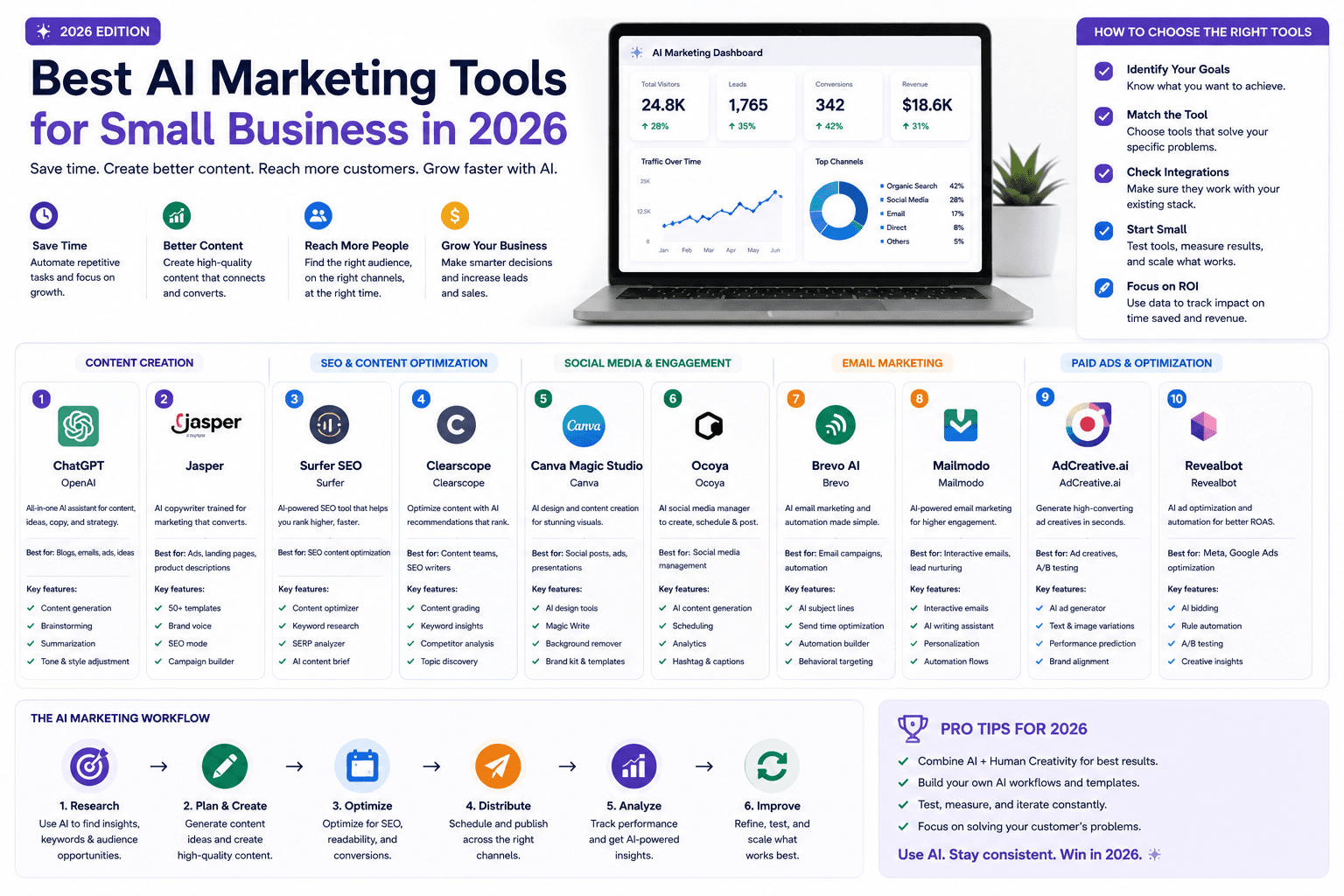
Best AI Marketing Tools for Small Business (2026): Stacks, Pricing & Picks
Compare the best AI marketing tools for small business in 2026 — ChatGPT, Canva, HubSpot, Brevo, Jasper, Buffer, Zapier, and more. Organized by job, budget, and upgrade trigger.
The AI edge, delivered every Tuesday
One 5-minute email: the tools worth your money, the plays that are working right now, and zero hype. Unsubscribe anytime.
No spam. No selling your data. Read by owners of restaurants, gyms, clinics, and agencies across the US, UK, Canada, and Australia.