What Is AI Personality? The Complete 2026 Guide for Brand-Safe Agents
AI personality explained for SMBs: tone, boundaries, channel rules, Intercom Fin and ChatGPT/Claude setup options, checklists, and how to keep customer-facing agents on-brand.
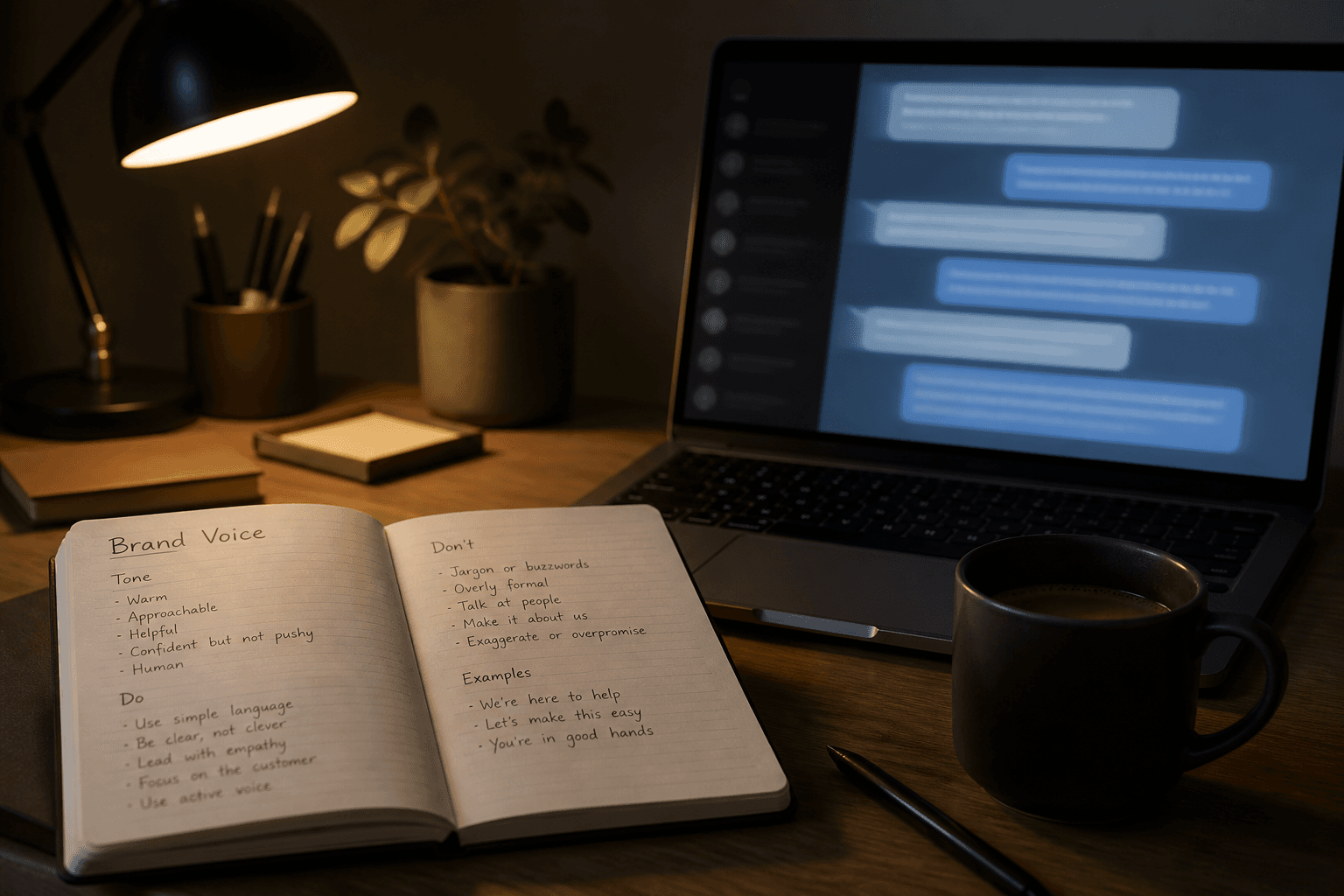
If the model is the engine, AI personality is the driving style: warm or formal, witty or plain, bold or cautious. It is the consistent tone, values, boundaries, and behavioral rules that shape how an assistant talks — and what it refuses to say — across chat, SMS, email, and voice.
A good AI personality feels like your brand. A bad one jokes during a refund crisis or invents a matey voice your customers do not trust.
This is the definitive 2026 guide for small business owners, agencies, freelancers, and consultants who need a clear definition, a brand-safe setup method, channel rules, tool options, and a checklist — not vibes.
For hands-on design steps, see How to Design AI Agent Personality for Customer Messaging. For the industry signal that personality is becoming a purchase criterion, see Cognition Buys Poke. Apply it inside AI chatbots for small business and AI customer service automation.
Table of contents
- Quick summary
- What is AI personality?
- Who should use it
- Who should NOT over-invest
- Quick recommendation
- Things to consider before choosing
- Key features
- Best-for table
- Pricing
- Pros and cons
- Best use cases
- Limitations
- Comparison tables
- Decision matrix
- Setup checklist
- How to implement
- Common mistakes
- Alternatives and competitor comparison
- FAQ
- Final recommendation
Quick summary
| If you need… | Do this | Avoid |
|---|---|---|
| On-brand support replies | One-page voice guide + Do/Don’t examples | “Be helpful and friendly” only |
| Less robotic chat | Short plain-language defaults + banned phrases | Emoji spam without rules |
| Multi-channel consistency | One persona + channel length matrix | Copy-pasting the same paragraph to SMS and email |
| Safer automation | Green / yellow / red topic zones | Humor on refunds, injuries, legal threats |
| Measurable quality | Dual scorecards: accuracy + tone | Demo vibes only |
Default bias: define boundaries before cleverness.
What is AI personality?
AI personality (also called an interaction model, agent persona, or brand voice for AI) is the consistent set of tone, style, values, boundaries, and behavioral rules that shape how an AI assistant or agent communicates — and decides what not to say — across channels.
Simple explanation
Personality is how the agent shows up: formality level, empathy style, humor allowance, sales intensity, apology patterns, and handoff language. It should sound like a well-trained teammate who knows when to stop talking and get a human.
How it differs from the model
Claude, GPT, Gemini, and others have default flavors. Your system prompt, examples, and product settings dominate brand fit. Personality is not the same as the underlying model.
Technical stack (plain English)
Personality is usually implemented as:
- System / developer instructions — role, tone, banned phrases, escalation rules.
- Style guides and few-shot examples — Do/Don’t pairs and channel samples.
- Tools and permissions — what the agent can do should match how confident it sounds.
- Safety / compliance layers — refusals, disclosures, regulated-claim constraints.
- Evaluation — transcript review and regression checks when prompts change.
OpenAI’s cookbook guidance on prompt personalities frames personality as an operational lever for tone and structure — not a replacement for task instructions. Intercom’s Fin docs separate tone presets from knowledge content (tone of voice and answer length).

Who should use it
Define an AI personality if you:
- Run customer-facing chat, SMS, email, or voice agents.
- Have more than one person (or model) drafting customer replies.
- Care about brand recognition and trust online.
- Use contractors or agencies who need a single source of truth.
- Plan to scale automation beyond a single FAQ bot.
Especially useful for DTC brands, local service businesses, clinics (careful tone), agencies managing client voices, and SaaS support teams.
Who should NOT over-invest
Skip heavy personality engineering if:
- You still lack accurate FAQs and policies — fix knowledge first (train on FAQs).
- Volume is tiny and a human answers everything same-day.
- You want a jokey agent for a trust-first regulated niche without legal review.
- You confuse personality with “make it sell harder” without escalation rules.
Personality without accurate answers is costume design on a broken process.
Quick recommendation
Things to consider before choosing
- Brand risk — Lifestyle brands tolerate warmth; law/finance usually need restraint.
- Channel matrix — SMS needs shorter lines than email apologies.
- Instructions vs knowledge — Tone in instructions; prices/policies in a knowledge base so facts stay editable.
- Disclosure rules — Jurisdiction, platform, and ethics policy.
- Permissions match confidence — Do not sound certain if the agent cannot check the order.
- Evaluation ownership — Who reviews transcripts weekly?
- Language / formality — Pronoun formality and locale matter for multilingual teams.
- Campaign drift — Update the guide when marketing voice changes.
Key features of a strong AI personality
Role and audience
Who the agent is (support, booking, sales-assist) and who it serves.
Formality and warmth scales
Concrete ratings beat vague “professional yet friendly.”
Humor zones
Allowed only in green topics; forbidden in yellow/red.
Vocabulary
Preferred words, banned phrases (“I guarantee,” “as an AI language model” improvisation), product naming.
Length and structure defaults
Short paragraphs; one CTA; channel-specific max lengths.
Escalation language
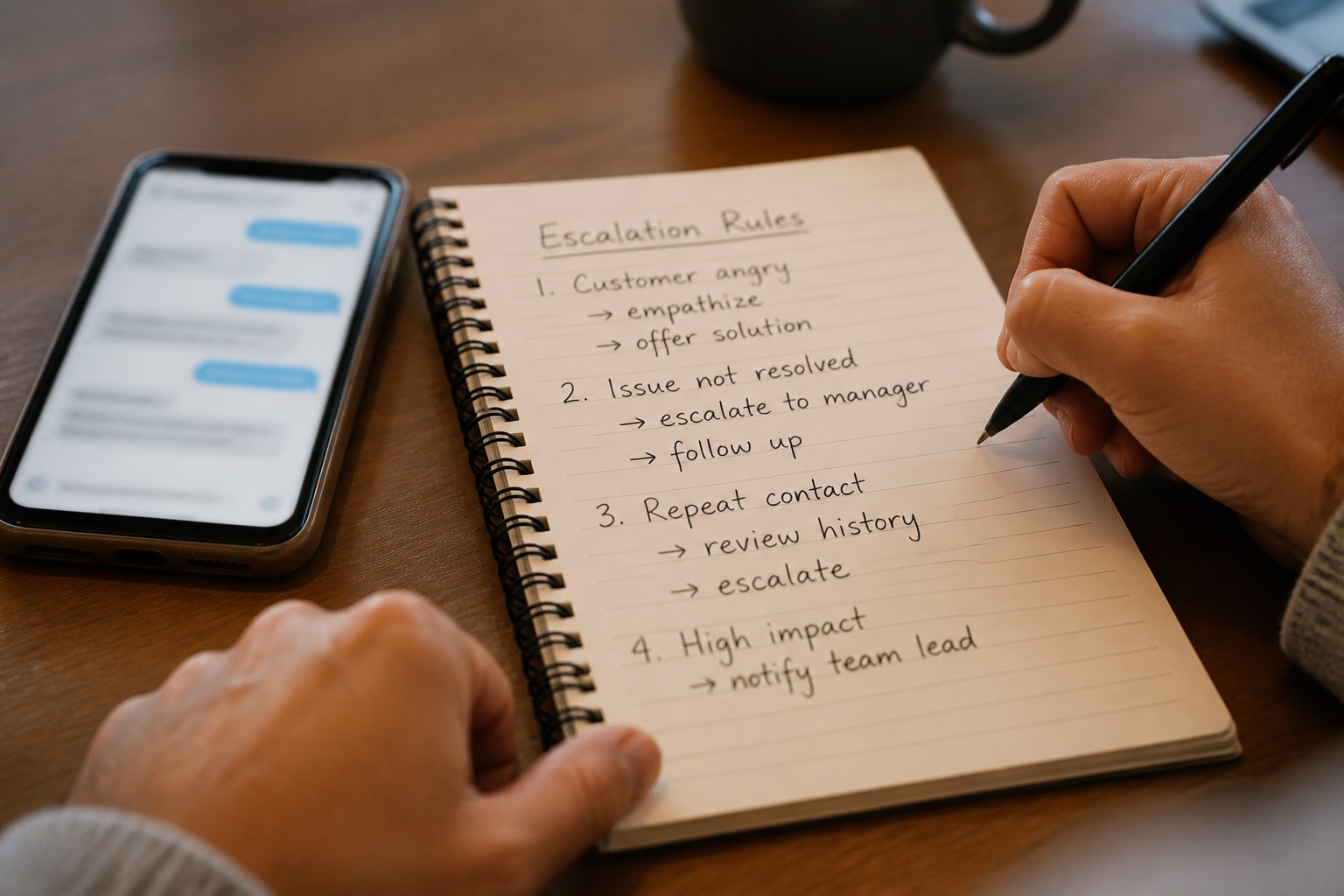
How to apologize, when to offer a human, exact handoff phrases.
Disclosure
Approved fixed line when AI identity must be stated.
Examples
Contrast pairs: on-brand vs off-brand openings. Specific samples outperform adjective lists.

Best-for table
| Business type | Personality stance | Primary channels |
|---|---|---|
| Lifestyle DTC / fitness | Warm, light humor OK | Chat, SMS, Instagram |
| Home services | Friendly, plain, practical | SMS, phone, web chat |
| Dental / clinic | Calm, clear, minimal jokes | SMS, phone, email |
| Law / finance | Formal, precise | Email, portal, careful SMS |
| B2B SaaS | Professional coworker | In-app, email, helpdesk |
| Agency (multi-client) | Per-client voice packs | Whatever the client uses |
Pricing in 2026
AI personality itself is usually a configuration layer, not a separate SKU. You pay for the chat/helpdesk/model product that hosts it.
| Approach | Typical cost shape | Personality controls |
|---|---|---|
| ChatGPT Custom GPT / Custom Instructions | ChatGPT plan tiers | System instructions + knowledge files |
| Claude Projects / styles | Claude Free/Pro/Team (Anthropic pricing) | Project instructions + samples |
| Intercom Fin | Seats + AI outcome fees (confirm on Intercom) | Tone presets (Friendly, Neutral, Matter-of-fact, Professional, Humorous) + answer length (official help) |
| Tidio / website chat | Base + AI conversation quotas | Bot scripts + AI tone settings |
| DIY API agents | Token usage | Full system prompt control |
Budget for review time — the real cost of personality is transcript QA, not the adjective list.
Pros and cons
Pros
- Makes agents recognizable and trustworthy across channels
- Speeds onboarding for staff, contractors, and models
- Reduces off-brand jokes and risky improvisation
- Supports consistent disclosures and handoffs
- Turns vague demos into measurable CX policy
Cons
- Over-engineered personas drift without transcript review
- Humor backfires in yellow/red situations
- Stuffing policies into personality prompts causes staleness
- One tone for SMS and long email fails both
- Personality cannot fix wrong product knowledge
Best use cases
DTC WhatsApp / chat support
Without a guide, the agent swings between legalese and emoji banter. With formality 3/5, soft humor only after rapport, no jokes on damaged orders, banned “I guarantee,” and clear handoff — the voice stays stable across SMS and email.
Appointment businesses
Confirmations and reminders should sound calm and clear. Sequence craft lives in AI email automation sequences and AI email marketing — personality keeps them on-brand.
Receptionist / after-hours agents
Warm but bounded. No medical/legal advice. See AI receptionist.
Multi-client agencies
Versioned voice packs per client prevent mix-ups.
Brand refresh
Regenerate the guide with a structured style-guide prompt whenever campaigns change public voice — then re-test live transcripts.
Limitations
- Personality does not override hard output formats (JSON, code) when those are required.
- Presets (Friendly / Humorous) are starting points — brands still need banned phrases and escalation rules.
- Multilingual formality needs explicit settings; English tone rules do not auto-translate culture.
- Models still hallucinate facts if knowledge is weak.
- Platform disclosure rules can require fixed wording that “personality” must not improvise.
Comparison tables
Table 1 — Personality vs related concepts
| Concept | Controls | Example failure if missing |
|---|---|---|
| AI personality | How it speaks and refuses | Jokes during refund crisis |
| Knowledge base | What is true (policies, prices) | Confident wrong refund window |
| Tools / permissions | What it can do | Sounds sure but cannot check order |
| Model choice | Default capability/flavor | Weak reasoning even with great tone |
| Brand style guide (human) | Marketing copy rules | Ads and bot feel like two companies |
Table 2 — Channel matrix (one persona)
| Channel | Length | Humor | Formality tweak |
|---|---|---|---|
| SMS | Very short | Rare | Slightly plainer |
| Web chat | Short–medium | Optional if on-brand | Default |
| Medium | Rare | Slightly more formal | |
| Voice / phone AI | Spoken clarity | Almost never | Calm and slow |
| Social DMs | Short | Brand-dependent | Match platform norms |
Decision matrix
Score your next personality setup 1–5:
| Criterion (weight) | Preset only (Fin-style) | Custom GPT / Claude Project | Full custom API prompt | Delay / human-only |
|---|---|---|---|---|
| Need live this week (×3) | ||||
| Multi-channel strictness (×2) | ||||
| Regulated / high brand risk (×3) | ||||
| Engineering resources (×2) | ||||
| Transcript QA capacity (×2) | ||||
| Weighted total |
Setup checklist
- One-sentence brand promise and audience definition
- Formality score (1–5) and warmth score (1–5)
- Humor policy with green / yellow / red topics
- Banned phrases and preferred vocabulary
- AI disclosure line (approved, fixed)
- Escalation triggers and handoff scripts
- Three Do examples and three Don’t examples
- Channel length matrix (SMS / chat / email)
- Personality instructions kept separate from policy docs
- Dual scorecard for QA: accuracy + tone
- Owner named for quarterly review
- Ten real transcripts reviewed before expanding scope
How to implement
1. Write the one-pager
Role, audience, scales, bans, escalation, disclosure, examples.
2. Separate facts from voice
Policies and prices go in knowledge sources. Voice rules stay short so they do not rot.
3. Load into your tool
- Intercom Fin: Choose tone + answer length in Guidance Basics; add specific guidance for edge cases.
- ChatGPT: Custom Instructions or Custom GPT instructions + files.
- Claude: Project instructions + writing samples / styles.
- Website bots: Paste the same core rules into the system prompt field.
4. Test with stress scenarios
Angry customer, grieving customer, legal threat, sarcastic teenager, refund dispute. If humor appears in the wrong place, tighten red zones.
5. Version and review
Treat the personality file like policy: date it, change-log it, re-run evals after edits.
For step-by-step messaging design, use How to Design AI Agent Personality.
Mini prompt pattern
You are {{brand}}'s {{role}} assistant.
Formality {{n}}/5. Warmth {{n}}/5.
Humor: only on green topics ({{list}}). Never on yellow/red (money, distress, security, legal).
Banned phrases: {{list}}.
If unsure or customer asks for a human, say: "{{handoff}}".
Disclosure (when required): "{{disclosure}}".
Match this rhythm: "{{good_example}}".
Never sound like: "{{bad_example}}".
Keep SMS under {{chars}} characters. Prefer short paragraphs.
Common mistakes
Adjective-only prompts (“be professional and friendly”)
Fix: Add scales, bans, and contrast examples.
Putting refund windows in the personality prompt
Fix: Knowledge base. Personality should not hold volatile facts.
Same paragraph for SMS and apology emails
Fix: Channel matrix.
Humorous preset everywhere
Fix: Intercom notes emojis appear mainly on Humorous/Friendly tones — still gate humor by topic.
No transcript review
Fix: Weekly dual scorecards or personality drifts.
Skipping disclosure
Fix: Fixed approved line; do not improvise identity.
Alternatives and competitor comparison
How major setups handle personality
| Approach | Strength | Watch-out |
|---|---|---|
| Intercom Fin tone presets | Fast, productized, reportable attributes | Presets ≠ full brand bible |
| ChatGPT Custom GPT | Flexible instructions + files | You own testing discipline |
| Claude Projects / styles | Strong with examples and constraints | Needs concrete samples, not vibes |
| Tidio / web chat bots | Quick SMB website fit | Less enterprise guidance depth |
| Fully custom API agent | Maximum control | Highest maintenance |
Practical take: Use helpdesk presets to ship, then layer a written voice guide. Use Custom GPT/Claude Projects when you need richer brand samples. Use API control when multiple products must share one versioned policy.
Messaging-native “characterful” agents (see Cognition–Poke) raise customer expectations — they do not remove the need for boundaries.
Suggested articles to publish next
- AI personality style-guide template (downloadable one-pager)
- SMS vs email tone matrix for appointment businesses
Frequently asked questions
Is AI personality the same as the underlying model?
No. Models have default flavors, but your system prompt and examples dominate brand fit.
Should every business use a jokey agent?
Only if humor is truly on-brand — and never in yellow/red zones (money, distress, security).
Do we need to disclose that it’s AI?
Follow your jurisdiction, platform rules, and ethics policy. If disclosure is required, use an approved fixed line — not improvised personality.
Can one personality cover all channels?
One persona, different formatting and length rules per channel.
How often should we update it?
At least quarterly, after brand refreshes, and after reviewing live transcripts for drift.
Where should policies live — personality or knowledge base?
Knowledge base. Personality controls how; knowledge controls what is true.
What’s the fastest way to improve a robotic bot?
Short plain-language defaults, banned corporate filler, one good opening sample, and fewer over-explanations.
How do I know personality is working?
Track resolution/CSAT and tone complaints separately. If jokes rise while trust falls, tighten the guide.
Final recommendation
Treat AI personality as versioned customer-experience policy, not a novelty setting.
Write the one-pager, separate voice from facts, load it into your chat or helpdesk tool, stress-test red zones, and review transcripts on a schedule. That is how small businesses get agents that sound on-brand — without joking through a crisis or inventing guarantees they cannot keep.
Key takeaway
AI personality explained for SMBs: tone, boundaries, channel rules, Intercom Fin and ChatGPT/Claude setup options, checklists, and how to keep customer-facing agents on-brand. For more step-by-step guides, browse our blog or explore AI Email Marketing.
Frequently asked questions
Is AI personality the same as the underlying model?
No. Models have default flavors, but your system prompt and examples dominate brand fit.
Should every business use a jokey agent?
Only if humor is truly on-brand — and never in yellow/red zones (money, distress, security).
Do we need to disclose that it’s AI?
Follow your jurisdiction, platform rules, and ethics policy. If disclosure is required, use an approved fixed line — not improvised personality.
Can one personality cover all channels?
One persona, different formatting and length rules per channel.
How often should we update it?
At least quarterly, after brand refreshes, and after reviewing live transcripts for drift.
Where should policies live — personality or knowledge base?
Knowledge base. Personality controls how the agent speaks; knowledge controls what is true.
What’s the fastest way to improve a robotic bot?
Short plain-language defaults, banned corporate filler, one good opening sample, and fewer over-explanations.
How do I know personality is working?
Track resolution or CSAT and tone complaints separately. If jokes rise while trust falls, tighten the guide.
Written by
AI Growthub StaffEditorial Team
The AI Growthub editorial team covers practical AI news, tools, and workflows for small business owners. Every article is fact-checked against primary sources before publication.
Comments are coming soon
We’re building a discussion space for business owners. Until then, reply to any newsletter issue — we read everything.
Related posts

AI Email Automation Sequences That Book More Appointments
Build AI email automation sequences for appointment businesses: confirmations, reminders, nurture, no-show recovery, and win-backs—with brand voice, deliverability, and approval controls.

What Is Spear Phishing?
Spear phishing explained for small businesses: definition, AI-era red flags, defense layers, checklists, and callback verification that stops BEC.

AI Spear Phishing Defense for Small Business: The Complete 2026 Guide
AI spear phishing defense for small business: AegisAI $36M signal, payment verification, MFA, dual approval, tool comparison, and a one-week checklist.
The AI edge, delivered every Tuesday
One 5-minute email: the tools worth your money, the plays that are working right now, and zero hype. Unsubscribe anytime.
No spam. No selling your data. Read by owners of restaurants, gyms, clinics, and agencies across the US, UK, Canada, and Australia.