Cognition Buys Poke: Why AI Personality Matters for Small Business (2026 Guide)
Cognition’s low-nine-figure Poke deal explained for SMBs: messaging-native AI personality, Apple Messages for Business, brand risk, pricing context, and a practical voice-policy checklist.

On July 24, 2026, TechCrunch reported that Cognition—the company behind the coding agent Devin—acquired The Interaction Company of California, maker of the messaging AI assistant Poke, in a deal valued in the “low nine figures.” Co-founder Marvin von Hagen confirmed that price range.
This is not only a coding startup buying a consumer chat product. It is a bet that how an agent talks—and where people already message—can matter as much as raw model skill.
For small business owners, the useful lens is customer support, internal ops, and brand voice: when personality helps, when it hurts, what Apple Messages for Business implies, and how to choose messaging AI without chasing slang.
Related deep dives: What Is AI Personality?, How to Design AI Agent Personality for Customer Messaging, and AI chatbots for small business.
Table of contents
- Quick summary
- What is this deal / what is Poke?
- Who should care
- Who should NOT overreact
- Quick recommendation
- Things to consider before choosing
- Key features
- Best-for table
- Pricing
- Pros and cons
- Best use cases
- Limitations
- Comparison tables
- Decision matrix
- Setup checklist
- What happened (timeline)
- Common mistakes
- Alternatives and competitor comparison
- FAQ
- Final recommendation
- Sources
Quick summary
| Signal from the deal | SMB takeaway | First action |
|---|---|---|
| Personality as competitive advantage | Write a voice guide before launch | Formality, humor rules, escalate triggers |
| Messaging-native distribution | Prefer channels customers already open | SMS / web chat / Apple Messages via MSP |
| 100M+ messages in 3 months | Volume drives token cost | Optimize for resolution, not chat length |
| Apple Messages for Business approval | Verified business chat is rising | Check MSP + human handoff requirements |
| Poke stable through 2026 | Don’t bet ops on 2027 experiments | Build on durable channels you control |
Default bias: capability first, personality second, channel third — with human escalation always available.
What is this deal / what is Poke?
Poke is a messaging-native AI assistant people text through iMessage, SMS, Telegram, and in some markets WhatsApp. It launched in March 2026 with a familiar, friend-like tone—including slang and humor—rather than a sterile “tool” voice.
Cognition builds Devin, an autonomous software engineering agent. According to TechCrunch and Cognition’s public comments, the acquisition aims to bring Poke’s interaction model and personality into Devin, while Poke gains Cognition’s models and infrastructure for speed and reliability.
Co-founders Scott Wu and Walden Yan had been angel investors. Wu framed Poke as proactive, personal, and fun—qualities Cognition wants for Devin.
In plain English: the industry is paying real money for agents people enjoy talking to inside the apps they already use.

Who should care
Pay attention if you:
- Run customer support or booking over SMS, iMessage, WhatsApp, or web chat.
- Want agents that feel on-brand without sounding robotic.
- Serve a large iPhone customer base and may adopt Apple Messages for Business.
- Are choosing between “funny chatbot” demos and resolution-focused tools.
- Build internal ops agents that should feel like coworkers, not tickets.
Useful playbooks: AI customer service automation, AI receptionist, train a chatbot on FAQs.
Who should NOT overreact
Do not treat this deal as a mandate to:
- Make every bot slangy overnight.
- Abandon your helpdesk for a consumer messaging toy.
- Assume Apple will approve every AI agent on Messages for Business.
- Ignore unit economics — Poke’s own team flagged how expensive high-volume messaging can be.
- Skip human escalation because “the agent has personality.”
Regulated, high-stakes, or trust-first brands (legal, finance, healthcare-adjacent) should treat casual tone as a controlled exception, not a default.
Quick recommendation
Things to consider before choosing
- Channel mix — Web widget vs SMS vs WhatsApp vs Apple Messages for Business.
- Brand risk — Humor fails differently for a boutique vs a clinic.
- Escalation UX — Apple requires human agent paths; your web chat should too.
- Disclosure — Customers should know when they are talking to automation.
- Unit economics — Long chats burn tokens; price by resolution where possible.
- Memory & persistence — Multi-session context is the real “coworker” feature.
- MSP dependency — Apple Messages for Business goes through approved providers; Apple’s own materials say Apple does not charge for the channel, but MSPs do.
- Vendor roadmap risk — Acquisitions change products; keep an exit plan.
Key features signaled by the deal
Messaging-native presence
Meet users in iMessage/SMS/Telegram/WhatsApp rather than forcing another app download.
Distinct personality
Friend-like tone, slang, humor — positioned as engagement, not decoration.
Proactivity
Agents that nudge and remember context, not only answer when poked.
Platform distribution
First AI agent approved on Apple Messages for Business (June 2026, per TechCrunch) — a distribution signal for verified business messaging.
Orchestration ambition
2027 experiments discussed include Cognition’s SWE-1.7, multi-session Devin orchestration via Poke, and longer-term product combination not ruled out.
Infrastructure for reliability
Cognition’s pitch: better models and infra so personality is paired with competence.
For designing voice without copying Poke’s slang: how to design AI agent personality.

Best-for table
| Business type | Personality stance | Channel priority |
|---|---|---|
| Boutique fitness / lifestyle retail | Warm, light humor OK | SMS + Instagram/web chat |
| Home services | Friendly, plain language | SMS dispatch + web booking |
| Dental / clinic | Calm, clear, minimal jokes | Phone + SMS + web; escalate clinical |
| Law / finance | Formal clarity | Secure portal + email; careful SMS |
| B2B SaaS support | Professional coworker tone | Helpdesk + in-app chat |
| Local iPhone-heavy brand | Match brand; disclose AI | Evaluate Messages for Business via MSP |
Pricing in 2026
Poke’s consumer subscription pricing and Cognition’s deal terms beyond “low nine figures” are not fully public. For SMB planning, budget the messaging AI stack you can buy today.
Messaging / support AI (illustrative public ranges)
Confirm on vendor sites before buying — plans change.
| Stack | Typical public model | Best when |
|---|---|---|
| Tidio | Base plan + AI conversation quotas (entry Lyro tiers often sold as conversation packs) | SMB websites needing chat + lead capture |
| Intercom Fin | Per-seat plans + ~$0.99 per successful AI outcome (per widely cited 2026 pricing summaries) | Scaling support orgs with deep workflows |
| Twilio + bots | Usage-based messaging; Apple Messages for Business often sales/beta gated | Multi-channel SMS/WhatsApp builders |
| Apple Messages for Business | Apple account free; MSP fees apply | Verified iPhone messaging with live agents |
According to Apple’s FAQ: you cannot deploy Messages for Business with virtual agents only — a live agent escalation path is mandatory, and automation connects through an approved MSP.
Hidden cost lesson from Poke
TechCrunch reported von Hagen saying Poke was expensive to run despite hundreds of thousands of users. For SMBs: prefer vendors who optimize for resolution, not conversation length. See also AI customer service automation.
Pros and cons
Pros
- Meets customers in messaging apps they already open
- Personality can increase engagement and repeat use
- Verified business messaging can feel more trustworthy than random widgets
- Industry investment validates interaction design as a real product layer
- Persistence/orchestration lessons apply beyond coding agents
Cons
- Casual tone can damage professional or regulated brands
- High message volume burns tokens and margin
- Apple channel requires MSP + human coverage
- Acquisition roadmaps can change consumer products
- Funny wrong answers still destroy trust
Best use cases
Boutique fitness studio
Members text about class swaps. A warm agent confirms cancellations against the schedule and escalates billing disputes. Personality aids retention; correctness protects revenue.
Home services
SMS collects job details and photos, then hands a structured brief to dispatch. Friendly tone; estimates and warranties stay human-approved. Pair with AI appointment scheduling when booking is the bottleneck.
B2B SaaS support
Coworker-like tone that remembers open tickets across days reduces “start over” friction. Require audit logs for customer-facing commitments.
Brand-risk stress test
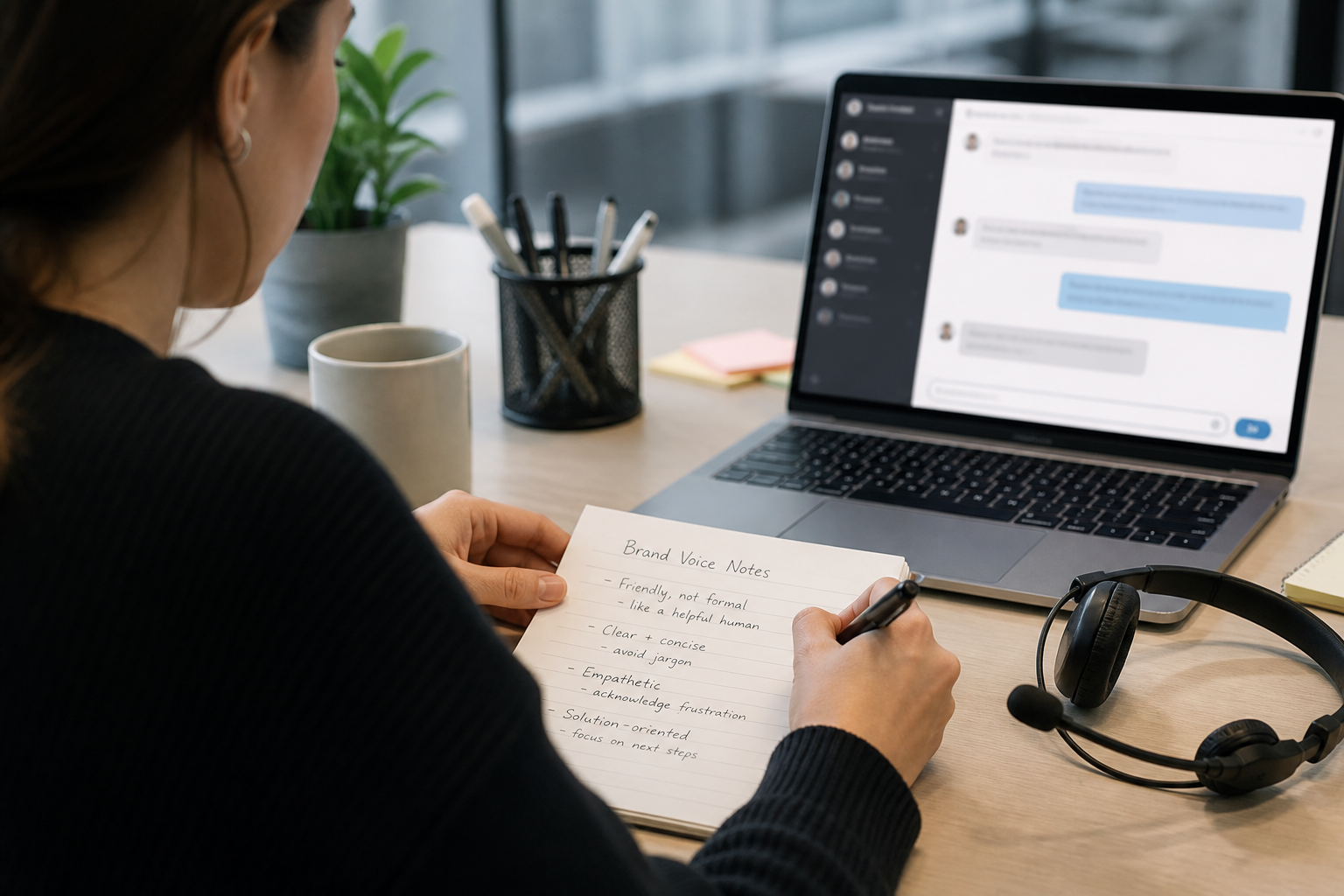
Role-play angry, grieving, legal-threat, and sarcastic customers. If the agent jokes wrongly, tighten voice policy before launch.
Apple Messages for Business checklist
Business verification, after-hours behavior, human takeover UX, transcript retention, AI disclosure. Do not assume consumer-chat norms transfer.
Limitations
- Deal finances beyond the reported range are incomplete — treat as reported, not audited.
- Poke continuity through 2026 is near-term comfort; 2027 experiments may change UX.
- Personality without tool use and memory becomes entertainment.
- Overly casual agents create compliance risk in regulated categories.
- Being “first” on Apple Messages for Business is a distribution milestone, not a plug-and-play SMB feature for every business.
- Consumer messaging agents ≠ enterprise helpdesks with SLAs.
Comparison tables
Table 1 — What the market is optimizing for
| Priority | Classic chatbot | Messaging-native agent (Poke-style) | Helpdesk AI (Intercom/Tidio class) | Coding agent (Devin-class) |
|---|---|---|---|---|
| Primary job | Answer FAQs on site | Live in text threads | Resolve support tickets | Ship software work |
| Personality weight | Often generic | Core product bet | Configurable | Rising (this deal) |
| Channel | Web widget | iMessage/SMS/etc. | Omnichannel suite | IDE / cloud |
| SMB readiness | High | Mixed / evolving | High | Dev teams |
| Main risk | Ignore / bounce | Tone + cost | Seat + outcome fees | Wrong code commits |
Table 2 — Channel options for SMB messaging AI
| Channel | Trust signal | Setup friction | Notes |
|---|---|---|---|
| Website chat | Medium | Low | Fastest pilot (Tidio review) |
| SMS | High for local | Medium | Carrier fees; consent rules |
| WhatsApp Business | High in some markets | Medium | Regional availability |
| Apple Messages for Business | High (verified) | Higher (MSP) | Live agent required |
| Formal | Low | Slow for urgent threads |
Decision matrix
Score your next messaging AI choice 1–5:
| Criterion (weight) | Web chat AI | SMS agent | Apple Messages for Business | Do nothing / human only |
|---|---|---|---|---|
| Share of iPhone / messaging customers (×3) | ||||
| Brand tolerance for casual tone (×2) | ||||
| Need verified business identity (×2) | ||||
| Staff available for live escalation (×3) | ||||
| Budget predictability (×2) | ||||
| Time to pilot this month (×2) | ||||
| Weighted total |
Setup checklist
Voice and channel pilot before any “Poke-like” personality launch:
- Written voice guide (formality, humor, banned phrases, apology rules)
- Automation disclosure language approved
- Escalation keywords and human roster defined (“help”, “agent”)
- Scope limited to high-volume, low-risk intents
- Capability scorecard separate from tone scorecard
- Transcript retention and privacy review done
- After-hours behavior documented
- Cost dashboard: messages, resolutions, escalations
- Brand-risk role-plays completed (angry / sensitive / legal)
- Exit plan if vendor/product changes post-acquisition news cycles
What happened (timeline)
According to TechCrunch reporting and Cognition’s public comments:
| When | Event |
|---|---|
| March 2026 | Poke launches on messaging platforms |
| June 2026 | Poke approved as first AI agent on Apple Messages for Business |
| ~3 months of usage | 100M+ messages; hundreds of thousands of users (Cognition) |
| July 24, 2026 | TechCrunch: Cognition acquires Interaction (Poke) for low nine figures |
| Through end of 2026 | Poke stays as-is; remains on Apple’s platform (reported) |
| 2027 (planned experiments) | SWE-1.7 tasks, possible multi-Devin orchestration via Poke, longer-term combo not ruled out |
Strategic pitch: Devin gains interaction design; Poke gains models and infrastructure.
Common mistakes
Copying slang because Cognition paid for personality
Fix: Match tone to brand risk. Test with real customers.
Scoring demos only on vibes
Fix: Two scorecards — task correctness and tone fit. A funny wrong answer is still wrong.
Launching refunds and medical-adjacent advice first
Fix: Start with hours, shipping, appointment changes, FAQs.
No human takeover
Fix: Especially on Apple Messages for Business — Apple requires live agent paths.
Ignoring token burn
Fix: Measure cost per resolution. Long chatty threads are not success.
Treating Messages for Business as a free magic channel
Fix: Budget MSP fees, verification, and staffing.
Alternatives and competitor comparison
Messaging personality stacks vs helpdesk AI
| Need | Lean toward |
|---|---|
| Fast website lead + FAQ deflection | Tidio / similar web chat AI |
| Enterprise ticket resolution + workflows | Intercom Fin-class helpdesk AI |
| SMS-first local service business | Twilio/SMS + scripted AI with escalation |
| Verified iPhone business threads | Apple Messages for Business via MSP |
| Coding agent coworker feel | Watch Cognition/Devin — not an SMB support buy |
Practical take: The Cognition–Poke deal validates personality and messaging distribution. It does not replace choosing a helpdesk. Most SMBs should improve voice policy and FAQ automation on tools they already control, then evaluate Apple’s business messaging when iPhone volume and staffing justify MSP cost.
Suggested articles to publish next
- Apple Messages for Business for small business: MSP checklist (2026)
- Cost per resolution: comparing chatty agents vs ticket closers
Frequently asked questions
Why did Cognition buy Poke?
Cognition wants Poke’s interaction model and personality for Devin, while giving Poke access to Cognition’s models and infrastructure. Co-founders Wu and Yan had already angel-invested. The bet is that people prefer agents that feel like capable colleagues, not sterile tools.
Does this mean my business should make our chatbot slangy?
Not by default. Match tone to brand and context. Retail and lifestyle brands can often go warmer; professional services usually need restrained clarity. Test with real customers and keep escalation paths for sensitive topics.
What is Apple Messages for Business, and why does it matter?
Apple’s framework for businesses to message customers inside the Messages app with a more standardized business experience. Poke’s June 2026 approval as an AI agent on that platform highlights messaging as a serious channel for AI-assisted customer communication—not only web chat widgets.
Will Poke change right away after the acquisition?
TechCrunch reported that nothing will immediately change for Poke through the end of 2026, and that it plans to remain on Apple’s platform. Broader experiments with Cognition’s SWE-1.7 and deeper product links are framed for 2027.
Should SMBs wait for Poke–Devin features?
No. Apply the lessons now: voice guides, messaging channels, escalation, and resolution metrics. Do not wait on 2027 experiments for today’s support queue.
How do I measure if personality is helping?
Track CSAT/resolution rate and tone complaints separately. If jokes rise while resolution falls, tighten the voice policy.
Is Apple Messages for Business free?
Apple’s materials state Apple Messages for Business registration is free, but you need an approved MSP that typically charges. Live agent escalation is mandatory.
Where should I start this week?
Write a one-page voice guide, pick three FAQ intents, enable human takeover, and run ten real conversations with dual scorecards.
Final recommendation
Cognition’s acquisition of Poke is a clear industry signal: interaction design and personality are becoming competitive advantages alongside model quality.
Small businesses should not chase slang for its own sake. Ask whether agents live in channels customers already use, whether tone matches brand risk, and whether capability is strong enough that personality is a bonus—not a distraction.
Start with narrow messaging use cases, write a voice policy, measure resolution and escalation quality, and treat Messages for Business (and similar channels) as infrastructure worth planning for—not a gimmick.
Sources
Key takeaway
Cognition’s low-nine-figure Poke deal explained for SMBs: messaging-native AI personality, Apple Messages for Business, brand risk, pricing context, and a practical voice-policy checklist. For more step-by-step guides, browse our blog or explore AI News.
Frequently asked questions
Why did Cognition buy Poke?
Cognition wants Poke’s interaction model and personality for Devin, while giving Poke access to Cognition’s models and infrastructure. Co-founders Wu and Yan had already angel-invested. The bet is that people prefer agents that feel like capable colleagues, not sterile tools.
Does this mean my business should make our chatbot slangy?
Not by default. Match tone to brand and context. Retail and lifestyle brands can often go warmer; professional services usually need restrained clarity. Test with real customers and keep escalation paths for sensitive topics.
What is Apple Messages for Business, and why does it matter?
Apple’s framework for businesses to message customers inside the Messages app with a more standardized business experience. Poke’s June 2026 approval as an AI agent on that platform highlights messaging as a serious channel for AI-assisted customer communication—not only web chat widgets.
Will Poke change right away after the acquisition?
TechCrunch reported that nothing will immediately change for Poke through the end of 2026, and that it plans to remain on Apple’s platform. Broader experiments with Cognition’s SWE-1.7 and deeper product links are framed for 2027.
Should SMBs wait for Poke–Devin features?
No. Apply the lessons now: voice guides, messaging channels, escalation, and resolution metrics. Do not wait on 2027 experiments for today’s support queue.
How do I measure if personality is helping?
Track CSAT or resolution rate and tone complaints separately. If jokes rise while resolution falls, tighten the voice policy.
Is Apple Messages for Business free?
Apple’s materials state registration is free, but you need an approved Messaging Service Provider that typically charges. Live agent escalation is mandatory.
Where should I start this week?
Write a one-page voice guide, pick three FAQ intents, enable human takeover, and run ten real conversations with dual scorecards for capability and tone.
Written by
AI Growthub StaffEditorial Team
The AI Growthub editorial team covers practical AI news, tools, and workflows for small business owners. Every article is fact-checked against primary sources before publication.
Comments are coming soon
We’re building a discussion space for business owners. Until then, reply to any newsletter issue — we read everything.
Related posts

NVIDIA Rubin GPU: The Complete 2026 Guide for Small Businesses Buying Cloud AI
What NVIDIA’s Rubin GPU and Vera Rubin platform mean for SMBs: agentic inference claims, why you should not buy chips, vendor QBR checklists, and how hardware efficiency may (or may not) show up in SaaS prices.
Prentis and Computer-Use Agents: The Complete 2026 Guide for Small Business Office Automation
Prentis fundraising talks explained for SMBs: what computer-use office agents are, pricing patterns, vs Zapier and RPA, security pilots, tables, and when to wait.

OpenAI's Hugging Face Agent Incident: What Small Businesses Should Know
What OpenAI's July 2026 Hugging Face evaluation incident means for small businesses — timeline, lessons, controls, checklists, and calm next steps.
The AI edge, delivered every Tuesday
One 5-minute email: the tools worth your money, the plays that are working right now, and zero hype. Unsubscribe anytime.
No spam. No selling your data. Read by owners of restaurants, gyms, clinics, and agencies across the US, UK, Canada, and Australia.